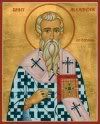
Stalinist culture considered that it represented the only escape from history and that the rest of the world had not yet entered the realm of pure mythology but remained historical. And it was here that Stalinist culture encountered its limit--it was swept away by the forces of history, because unlike Christianity it had failed to establish itself in the superhistorical; and when the extrahistorical competes with the historical, it inevitably loses, because it is fighting on alien ground.
Boris Groys
Thursday, April 12, 2007
Stalin's mistake


Monday, April 09, 2007
Christ is Risen
No one is so all-embracing as is the Lord Jesus. Who, of those so-called philanthropists of mankind, teachers, leaders or enlighteners ever attempted to perform any good for the dead?
St. Nikolai (Velimirovic)
Wednesday, April 04, 2007
The order of knowledge
...the lovers of God are not simpletons because they know God well enough that they are able to love Him. Of all human knowledge, this knowledge is more important and greater. To this must be added that the enemies of God cannot be more knowledgeable, even though they consider themselves as such, because their knowledge is unavoidably chaotic, for it does not have a source and does not have order. For the source and order of all knowledge is God.
St. Nikolai (Velimirovic)
Monday, April 02, 2007
Where is your goat's trail to be found?
Most men are surrendered unto Satan and run after wealth and other things of this life. But there are a few who believe with simplicity in the words of Christ. And again among these are found a few who go and live far away from the world, struggling and walking their whole life on the narrow and arduous goat's trail which our Lord showed us. They go to the desert and seek to find the hidden door of Paradise. These blessed men are not mistaken, but rather, know well where their ancient Fatherland is found.
From the life of St. Mark the Anchorite
Friday, March 30, 2007
Christ among us
Churches, shrines, chapels, ikons, candles, processions, priests, bells, monasteries, travelling preachers, every day's saints, fast seasons—everything is the repetition of the same idea, namely, that Christ is the ruler of life and we are His followers. Christ must be expressed everywhere, indoors and outdoors. Many Englishmen have remarked that the Bible is read very seldom in the home in Russia and Serbia. That is true. People read the Bible more in symbols, pictures and signs, in music and prayers, than in the Book, Our religion is not a book religion, not even a learned religion. It is a dramatic mystery. The Bible contains the words, but in this dramatic mystery there is something higher and deeper than words. Slav Christianity is something greater than the Bible. Looking at an ikon, a Russian mujik perceives the Bible incarnated in a saint's life-drama. Mystery of sin, mystery of atonement, mystery of heroic suffering, mystery of the daily presence of Christ among us in holy wine, in holy bread, in holy water, in holy word, in holy deed, in every sanctified substance, even in matter as in spirit, mystery of communion of sins and of virtues—all are recorded once in the Bible, and all are recorded and repeated also in our daily life—that is what we call our Slav Orthodoxy. We take the mystic outlines of the Bible and do not care about the details. In those mystic outlines we put our daily life, with its details of sins and sufferings.
St. Nikolaj (Velimirovic)
Wednesday, March 28, 2007
On "liturgical piety"
...it is difficult to reconcile oneself also to the term 'liturgical piety.' In the ordinary usage of words, piety is Christian faith, hope and love, independently of the forms of their expression. Such an understanding is instilled in us by the sacred Scriptures, which distinguish only authentic piety (piety is profitable unto all things - I Tim. 4:8) from false or empty piety (James 1:26, II Tim. 3:5). Piety is expressed in prayer, in Divine services, and the forms of its expression vary depending on circumstances: whether in church, at home, in prison, or in the catacombs, But we Orthodox scarcely need a special term like 'liturgical piety' or 'church piety,' as if one were pious in a different manner in church than at home, and as if there existed two kinds of religiousness: 'religiousness of faith' and 'religiousness of cult.' Both the language of the Holy Fathers and the language of theology have always done without such a concept. And therefore it is a new conception, foreign to us, of a special liturgical piety.
If we speak of worship as members of the Orthodox Church, there should be present to us that principle in the understanding of the history of our worship and its present status by which the Church Herself lives. ...if we maintain the Orthodox Symbol of Faith, if we confess that we stand on the right dogmatic path, we should not doubt that both the direction of church life and the structure of worship which was erected on the foundation of our Orthodox confession of faith, are faultless and true. We cannot acknowledge that our 'liturgical piety,' after a series of reformations, has gone far, far away from the spirit of Apostolic times.
Fr. Michael Pomazansky
...piety is, as it were, the groundwork and foundation of perfection.
St. Basil the Great
Monday, March 26, 2007
On Creation
I want creation to penetrate you with so much admiration that everywhere, wherever you may be, the least plant may bring to you the clear remembrance of the Creator.
...shall we, whom the Lord, the great worker of marvels, calls to the contemplation of His own works, tire of looking at them, or be slow to hear the words of the Holy Spirit? Shall we not rather stand around the vast and varied workshop of divine creation and, carried back in mind to the times of old, shall we not view all the order of creation?
...the sight of the moon, making us think of the rapid vicissitudes of human things, ought to teach us not to pride ourselves on the good things of this life, and not to glory in our power, not to be carried away by uncertain riches, to despise our flesh which is subject to change, and to take care of the soul, for its good is unmoved.
...the world was not conceived by chance and without reason, but for an useful end and for the great advantage of all beings, since it is really the school where reasonable souls exercise themselves, the training ground where they learn to know God; since by the sight of visible and sensible things the mind is led, as by a hand, to the contemplation of invisible things.
St. Basil the Great
Wednesday, March 21, 2007
The first place
Even today common enemies make peace among themselves when they find it necessary to attack and condemn the Lord. There are many who kill one another until you mention the Name of the Lord to them. As soon as they hear that Name, they gradually make peace among themselves for the sake of attacking that Holy Name. It is easier for the unjust to tolerate the unjust than it is for them to tolerate the just. It is easier for the unjust to come to an understanding and reconciliation with the unjust than with the just.
Even in some countries, the most quarrelsome parties seek reconciliation among themselves when it is deemed necessary to decide what place should be given to the Lord Jesus Christ in the State, either to render Him the first place, which is befitting to Him, or the last place? To these questions sworn enemies reconcile among themselves in order that our Lord will be given the last place only. So, also, it was with the quarreling parties of Pharisees and Saducees who were reconciled and entered into a partnership against Christ.
Why is it that the Most Pure and the Most Needed had to be awarded the last place? Because, according to their thinking, the first place would then be reserved for them. The same incentive was there between sworn enemies, the Pharisees and Saducees, when it was deemed necessary to seek to put Christ to death. The same incentive was the occasion that caused the reconciliation between Pilate and Herod when it was deemed necessary to judge that Christ had to be put to death.
St. Nikolaj (Velimirovic)
Monday, March 19, 2007
The ideal of repentance
...repentance from things better to things worse is a change impossible to us.
St. Polycarp of Smyrna
Saturday, March 17, 2007
The terrible judgement
He who does not see God as the merciful Samaritan on earth will see Him as the Dreadful Judge in Heaven.
St. Nikolaj (Velimirovic)
"...I say unto you, Hereafter shall ye see the Son of man sitting on the right hand of power, and coming in the clouds of heaven." [Matthew 26:64]
Friday, March 16, 2007
The evocation of contrition
In the countries of Europe there are churches with paintings that are famous for their artistic merit; yet they do not have the mystery and the power of evoking contrition possessed by the icons that were done by some unlettered and simple Byzantine painters.What a simple way to discredit Western Art, no?
Fotis Kontoglou
Thursday, March 15, 2007
No light comes from the West
The Eastern light has come to the West -- to the uttermost Western end. And blessed be they who, with a clear vision, perceive this light just as it shines in the East. This light, although it came from the East, did not change, but while it shines in the West, it continues to be the light of the East; it is the Eternal Light. Christ, Who is the East Himself, laid down Himself as the chief cornerstone of His Church, which He established in the East, and they in the West who receive this Light of the East, must so shine as the Light of the East would have them be enlightened; but not allow themselves to be dazzled with the glare of a false fire; I say fire, but not light, as no light comes from the West! Praise and glorify the Good God! See, He comes to the West from the East, that all may see by that One Light, and be saved in the bond of union, which is love!I've always been perplexed when people dislike using the term "Eastern" to refer to our Church. Seems to me like it is a new heresy of our times. I think I will call it "ненавистники восточного Христоса" - Haters of the Eastern Christ.
Archimandrite Sebastian (Dabovic)
Wednesday, March 14, 2007
Another lenten reminder
St. John Chrysostom writes thusly against those who create a disturbance in church and who depart from church before the completion of the Divine Liturgical Service of God. 'Some do not approach Holy Communion with trembling but with commotion, shoving one another, burning with anger, hollering, scolding, pushing their neighbor, full of disturbance. About this, I have often spoken and will not cease to speak about this. Do you not see the order of behavior at the pagan Olympic games when the Arranger passes through the arena with a wreath on his head, dressed in a lengthy garment, holding a staff in his hand and the Crier declares that there be silence and order? Is it not obscene that there, where the devil reigns there is such silence, and here where Christ invites us to Himself there is such an uproar. At the arena, silence: and in church, uproar! On the sea, calm and in the harbor, tempest! When you are invited to a meal, you must not leave before the others, even though you are satisfied before the others, and here while the awesome mystery of Christ is being celebrated, while the priestly functions are still continuing, you leave in the middle of it and exit? How can this be forgiven? How can this be justified? Judas, after receiving Communion at the Last Supper [Mystical Supper] that final night, departed quickly while the others remained at the table. Behold, whose example do they follow who hurry to depart before the final thanksgiving?' (Homily on the Feast of the Epiphany).
St. Nikolaj (Velimirovic)
Tuesday, March 13, 2007
The path of the sunflower
The only true means for attaining our happiness in this life and in the next is the constant turning of our attention within ourselves, to our own conscience, to our thoughts, words, and deeds, so as to raise them to passionlessness: this will reveal to us our mistakes in life and indicate the only path to salvation. This path is the entire devotion of our whole being, of our whole self with all the circumstances of our life, to the will of God. As a symbol of this our turning to God we may take the growth of the sunflower; let it be ever before our eyes.
Christian! Observe once and for all how the sunflower even on gloomy days pursues its circular course, following the sun with the unchanging love and attraction natural to it. Our sun, illuminating our path through this world, it the will of God; it does not always illuminate our path in life without clouds; often clear days are followed by gloomy ones: rain, wind, storms, arise... But let our love for our Sun, the will of God, be so strong that we may continue, inseparably from it, even in days of misfortune and sorrow, like the sunflower on gloomy days, to navigate faultlessly on the sea of life, following the indications of the 'barometer' and 'compass' of the will of God, which leads us into the safe harbor of eternity.
St. John (Maximovitch) of Tobolsk
Friday, March 09, 2007
The salvation of the ignorant
By what can the ignorant be saved? By nothing except by faith in Christ and faith to Christ. Who are the most ignorant ones in the world? They are those who deny whatever Christ claimed and claim whatever He denied. In a word: there are those who think that they know something contrary to the knowledge of Christ. They are the worst and the most dangerous ignorant ones both to themselves and to others.
St. Nikolaj (Velimirovic)
Thursday, March 08, 2007
On Susceptibility
If you have not faith, do not fear beasts so much as your faithlessness, which renders you susceptible of all corruption.
St. Basil the Great
Wednesday, March 07, 2007
The true hierarchy
Which hierarchy is the true and lawful one? It is the priesthood which has retained and continues to follow these conditions:
1. In the first place such a hierarchy is true, which has received the grace of the Holy Spirit from the Apostles themselves in an unbroken line of succession from one to another. ...In the time when the erring Church of Rome spawned the Protestant sects, the Protestants commenced to elect and establish presbyters themselves, and these ministers not only baptize, but they officiate at a so-called "communion service," which of course is not a valid sacrament, as the ministers have no apostolic ordination and are not presbyters.
2. Secondly, an authentic hierarchy is such, which confesses all the truths of holy religion, for there are heresies which entirely deprive bishops and priests of their ministerial grace.
3. Thirdly, a Priesthood to be lawful must administer the Sacraments orderly, according to the rules of the Holy Church Catholic, not changing essential actions, as there are acts and conditions in the rites of Mysteries that are essential, without which a certain Sacrament may not be valid.
4. Fourthly, to be a lawful and true hierarchy, the same must be governed and govern its spiritual charge according to the rules of the Holy Apostles, the Seven Ecumenical Councils, and other laws which are accepted by the Orthodox Church in general.
5. A fifth condition necessary for proving the lawfulness of the Priesthood is its unity with the Orthodox Church in the spirit of peace and love. Whoever destroys this unity, except for a genuine and important cause, and bishops and priests together with Christians who follow them, that separate themselves from the higher Church authorities, are excommunicated from the Church, according to the rules of the Apostles and the canons of the Councils.
Archimandrite Sebastian (Dabovic)
Tuesday, March 06, 2007
The least plants
The whole universe cannot give us a right idea of the greatness of God; and it is only by signs, weak and slight in themselves, often by the help of the smallest insects and of the least plants, that we raise ourselves to Him.
St. Basil the Great
Monday, March 05, 2007
Put out into deep water
In shallow waters there are only small fish; that is the entire catch. But in the greater depths, the danger is also greater. There you have large sea creatures and great storms. That is dangerous. But there are also much larger and better fish in enormous quantity; that is the catch. O, enlightened one, come therefore into the deep! "Put out into the deep" mysterious sea of life, but do not set out without Christ in your boat. By no means. ... Perhaps the winds could carry you away and cast you into an abyss. Perhaps the monstrous and enormous beasts of the sea will consume you. The winds, O enlightened one, those are your own passions which accompany you unavoidably if you set out into the deep without Christ.
St. Nikolaj (Velimirovic)
Friday, March 02, 2007
To remember during Lent
The time which you lend to God is not lost: he will return it to you with large interest.And while you're lending your time remember this.
St. Basil the Great
Thursday, March 01, 2007
The troubles of the world
What a troublesome world this is, when one has the most right to expect it to be as agreeable as possible!
Clara Copperfield (Murdstone)
Wednesday, February 28, 2007
Apropos to the feast of St. Nicholas the Fool for Christ
'Fools for Christ' were distinguished by rare fearlessness. Blessed Nicholas ran throughout the streets of Pskov pretending insanity rebuking the people for their hidden, sins and prophesying that which will befall them. When Ivan the Terrible entered Pskov, the entire town was in fear and terror of the Terrible Tsar. As a welcome to the Tsar, bread and salt was placed in front of every home but the people did not appear. When the mayor of the town presented the Tsar with bread and salt on a tray before the church, the Tsar pushed the tray away and the bread and salt fell to the ground. At that time, Blessed Nicholas appeared before the Tsar in a long shirt tied with a rope, hopping around on a cane as a child and then cried out: 'Ivanuska, Ivanuska, eat bread and salt and not human blood.' The soldiers rushed out to catch him but he fled and hid. The Tsar learning about this Blessed Nicholas, who and what he is, visited him in his scant living quarters. It was the first week of the Honorable Fast [The First Week of Lent]. Upon hearing that the Tsar was coming to visit him, Nicholas found a piece of raw meat and when the Tsar entered his living quarters, he bowed and offered the meat to the Tsar. 'Eat Ivanusha, eat!' Angrily, the Terrible Tsar replied: 'I am a Christian and I do not eat meat during the Fast Season.' Then the man of God quickly responded to him: 'But you do even worse: you feed on men's flesh and blood, forgetting not only Lent but also God!' This lesson entered profoundly into the heart of Tsar Ivan and he, ashamed, immediately departed Pskov where he had intended to perpetrate a great massacre.
St. Nikolaj (Velimirovic)
The offerings of the educated
...what does our educated society have to offer, they who so love to make free and self-confident judgements concerning every question and contemporary event? -- Nothing but a market-place, where every kind of cheap liberal idea and opinion is offered and exchanged... Someone must open the eyes of these careless and blinded people, who are going to their destruction and drawing after them a great people!
Archbishop Amvrossy of Kharkov
Tuesday, February 27, 2007
The destruction of satan and the "invisible church"
An abstract federation of communities whereby each body is a member of a more general body reduces the Eucharist to a secondary position and makes possible the heretical idea that there is a membership in the body of Christ higher and more profound than the corporate life of local love for real people and thus the whole meaning of the incarnation of God and the destruction of Satan in a certain place and at a certain time in history is destroyed.
Fr. John Romanides
Monday, February 26, 2007
The ark of holy things
Those who know and accept and believe the prophetic visions, as the Divine himself gave them shape and form, which the chorus of prophets behold and explain; and who, strengthened by the written and unwritten tradition of the Apostles, continuing to the Fathers, therefore express holy things in images and honour them:
May their memory be eternal!
Synodikon of Orthodoxy
I believe...in one, holy, universal, and apostolic Church.
Wayfarers, behold the ark! When the flood came, Noah was saved in a secure ark. The flood of madness and sin continues incessantly. Therefore, the Lover of Mankind constructed the ark of salvation. Ask for His ark, and you will soon be entering it.
Do not let yourselves be led astray by the multitude of variegated vessels, decorated and adorned on the outside. Ask about the power of the engine and about the skill of the captain. The most powerful engine and the most skillful helmsman are to be found in the ark of Christ. This is the all-seeing, all-powerful, Holy Spirit himself.
Neither let yourselves be led astray by those who invite you into their tiny and new rowboats, or those who offer you private rowboats just for yourselves. The journey is distant and the storms are dangerous.
Neither let yourselves be led astray by those who say that on the other side of the ocean there is no new land, no new world, and that there is no reason to prepare for a distant voyage. They invite you to go fishing on the shore. To such a little extent do they see or know. Truly, they are setting out for destruction, and are inviting you to destruction as well.
Do not allow yourselves to be deceived, but rather ask about His ark. Even though it may be less dazzling to the eyes than others, nevertheless it is strong and secure. Even though it does not have many variegated banners, except the sign of the cross, know that your life is safe aboard it. And on a sea voyage the first and primary concern should be that the life of the passenger is safe.
St. Nikolaj (Velimirovic)
Friday, February 23, 2007
Grant it, O Lord
I have no tears, no repentance, no compunction -- my God and Savior, grant these to me!
St. Andrew of Crete
What is that blessed day? It is the day of self-judgement. When that day dawns, the man who has condemned the whole world until then will at once come to regard himself as the greatest stain on the whole of God’s earth. He will be ashamed before God; he will be ashamed before every man and before everything that God has created on earth. And this shame will begin to burn him like fire. And he will then acknowledge and confess: 'Truly I am the greatest stain on God’s earth. Truly, are all other men not better than I am? …O Lord, Lord, have pity on me a sinner and rescue me from the mire of my sins, that I may so much as begin to resemble Your creation.' My brother, do not expect that blessed day of repentance to come of itself. Take firm hold on yourself the first day that it comes to meet you, and say: 'You are the blessed day on which I shall purchase life eternal!'
St Nikolai (Velimirovic)
Thursday, February 22, 2007
Nail my flesh
Let us crucify our member through abstinence; and as it is written, let us be vigilant in prayer, living after the example of Him who suffered; by His passion, putting to death the passions.
Irmos of Matins, Wednesday, First week of Lent
Nail my flesh with the fear of you, O Christ, Who nailed the sin of Adam to the cross. Loose me from the bonds of wickedness, shatter the arrows of the evil one with Your Lance, Master, and deliver me from all his mischief.
Irmos of Matins, Wednesday, First week of Lent
Beloved, our condition needs much endurance; and endurance is produced when doctrines are deeply rooted. ...the soul which is nailed by the fear of God none will be able to overturn. ... Thus the Prophet prayeth, saying, "Nail my flesh by Thy fear" (Ps. 118: 120, LXX.); "do Thou so fix and join me, as by a nail riveted into me." For as men of this kind are hard to be captured, so the opposite sort are a ready prey, and are easily thrown down.
St. John Chrysostom
Wednesday, February 21, 2007
The light-giving season
Lord, You have consecrated and given us this light-giving season of abstinence, enable us all to pass through it in compunction and sincerity, living in peace by the power of the Cross, only Lover of mankind!
Hymn of Matins, Wednesday, First week of Lent
Tuesday, February 20, 2007
Spiritual meat
The season of repentance is at hand: show the fruits of abstinence, O my soul! Consider those who repented in the past and cry aloud to Christ: I have sinned, O Loving Master; save me, as You saved the Publican who sighed with sorrow from his heart, for You alone are rich in Mercy!
Hymn of Matins, Tuesday, first week of Lent
Restrain yourself, soul, from harmful passions, from hate and envy and from every evil. Be nourished in the fast with the spiritual meat from Heaven, which is the Word of God.
Irmos of Matins, Tuesday, first week of Lent
As the Lord killed the enemy by fasting, so let us also come to destroy his arrows and spears, saying: get behind me Satan! When he comes to tempt us.
Irmos of Matins, Tuesday, first week of Lent
Monday, February 19, 2007
Apropos to the first day of the Great Fast
For eating is also a matter of habit.
Abba Dorotheos
This is the time of repentance. This is the day of salvation. This is the beginning of the fast. Be vigilant, my soul! Close the door of your passions and seek the Lord.
Let us present a good fast, well-pleasing to the Lord! A true fast is alienation from the evil one; the holding of one's tongue, the laying aside of all anger, the removal of all sensuality, of accusation, falsehood and sins of swearing. The weakening of these will make the fast true and well-pleasing.
The principle of Christianity
People who deny the Church constantly speak about 'evangelical principles,' about evangelical teaching; but Christianity as life is completely alien to them . . .
St. Hilarion (Troitsky)
Saturday, February 17, 2007
Five year plan x2
I know you've all been eagerly awaiting an update on the actions of famed new ecumenical group CCT so I will not disappoint... Having just concluded their "celebration" of formation last week they could not fail to release some "objectives" towards which all "Christians and all people" need to strive.
Being not quite as ambitious as Stalin they will expand their plan from 5 years to 10, but no bother. Before laying out these objectives we must first get you in the "spirit" and remind you that "The Gospel and our ethical principles place our service of the poor and vulnerable and our work for justice at the center of Christian life and witness." (As if stating that "justice's" foundation is in the Gospel isn't enough they have to invoke those ambiguous "ethical principles".) Let's see what St. Isaac the Syrian says about this so-called "justice" talked of in the Gospels, "how can you call God just when you come to the passage about the laborers' wages [Matt. 20:1-16] Where is God's justice? ...Do not call God just, for His justice is not made known in your affairs ...He is good, as He says, to the evil and the ungodly."
Laying aside the fact that the center of the Christian life is actually the Eucharist we'll proceed. Next, to inspire your sense of "justice" some cheerleader phrases and lofty goals would be good, "...we can, we must, do more. Our goal must be the elimination of poverty in this land." I can almost hear Stalin's 1925 era voice through the crackly speaker perched high above red square...
Lest you forget who is calling you to action I will remind you that they are "representatives of almost all the families in Christianity in the United States: Evangelicals/Pentecostals, Catholics, Racial/Ethnic, Orthodox and Historic Protestants." (Grammatical correctness aside, if I had a bad dream and were the "ecumenical officer" from the Orthodox Church present when this was written I think I would have objected to being called an Orthodox Protestant.)
And don't forget kids, in 10 short years you'll be poverty free!
[Edit: See superb article here.]
The Artisan
But what kind of artist on earth can be compared to Christ the Artist, who from illiterate men creates wise men, who from fishermen creates apostles, who from cowards creates heroes, who from the immoral creates saints?
St. Nikolaj (Velimirovic)
Friday, February 16, 2007
The virtue of gluttony
Christianity is food and drink. And the more one eats of it, the more the mind is stimulated by the sweetness; it is uncontrollable and insatiate, insatiably asking for more eating
St. Macarius the Great
Thursday, February 15, 2007
The word of Christ
...what does it mean, brethren, to keep the word of Christ within ourselves? That means; First: to keep the word of Christ in our mind, thinking about it; Second: to keep the word of Christ in our heart, loving it; Third: to keep the word of Christ in our will, fulfilling it in deeds; Fourth: to keep the word of Christ on our tongue, openly confessing it when it is necessary to do so. Thus, to keep the word of Christ means to fill ourselves with it and to fulfill it. Whoever would keep the word of Christ in this manner, truly, he will never taste of death.
St. Nikolaj (Velimirivic)
Tuesday, February 13, 2007
Outward resemblances
All that can be said in regard to the platonism of the Fathers, and especially in regard to the dependence of the author of the Areopagitica on the neo-platonist philosophers, is limited to outward resemblances which do not go to the root of their teaching, and relate only to a vocabulary which was common to the age.May we in like manner speak of the "Western captivity" of Orthodoxy? I think so.
Vladimir Lossky
Sunday, February 11, 2007
In preparation for Great Lent
Today is celebrated the memory of St. Theodora who after the death of her iconoclast husband restored the veneration of icons in 842. Of course this is where the feast we celebrate in two weeks, the Sunday of Orthodoxy, originates. Today's commemorations also "happen" to coincide with the Sunday of the last judgment reminding us that those who do not recognize Christ in "the least of these" will be sent into "the everlasting fire prepared for the devil and his angels". It seems to me reasonable to recognize that seeing Christ in "the least of these" includes many of the saints we venerate on icons. Having recently read the life of St. Symeon of Emesa, fool for Christ, I could not help but see in his life such an example as fools for Christ take on a much more humble position than your run of the mill monk. Recently I posted a great explanation of the fool for Christ phenomenon which well sums up this thought.
And don't forget that today is also the commemoration of St. Blaise of Sebaste the patron of my bosom buddy Bleys, otherwise known as Colonel K.
And don't forget that today is also the commemoration of St. Blaise of Sebaste the patron of my bosom buddy Bleys, otherwise known as Colonel K.
Friday, February 09, 2007
The ludicrous ways of saints
...the all-wise Symeon's whole goal was this: first, to save souls, whether through afflictions which he sent them in ludicrous or methodical ways, or through miracles which he performed while seeming not to understand, or through maxims which he said to them while playing the fool; and second, that his virtue not be known, and he receive neither approval nor honor from men.
Leontius of Neapolis
Thursday, February 08, 2007
D.I.Y.
A brother said to Antony, 'Pray for me,' He answered, 'Neither I nor God will have mercy on you unless you do something about it yourself and ask God's help.'
Sayings of the Desert Fathers
Wednesday, February 07, 2007
Tuesday, February 06, 2007
The speech of faith
Separate aspects of faith disintegrate only for scholastic theology, but, in living life, these aspects, each retaining its independence, become so closely interwoven that one idea imperceptibly evokes another. For a scholastic theologian, it is easy to say that the concepts Church, Holy Spirit, and Son of God are different: easy, because in his consciousness they are only concepts. But for a believer for whom all of these are realities that cannot be experienced independently of one another, realities that are interpenetrating and interconnected; for a believer who perceives them in their living givenness; for whom the Church is tangibly the body of Christ, the fullness of the Spirit sent by Christ; for such a believer, it is painful to make sharp divisions and separations, for they cut through living flesh. The speech of faith is in no wise like the speech of theology, and faith clothes its knowledge of dogmatic truth in a symbolic garment, in figurative language, which covers the higher truth and depth of contemplation in consistent contradictions.
St. Pavel (Florensky)
Monday, February 05, 2007
Don’t fret “Byzantium” was egalitarian
Byzantine architecture, with its interpretation of the Church as the Trinitarian mode of existence, marks out a space which is concrete and yet without bounds, a space continually divided up which yet has its center everywhere. The eucharist is accomplished everywhere, in the place where each Christian is present, bearing in himself Christ and the Spirit.
Christos Yannaras
Friday, February 02, 2007
Have it their way
Walking across campus today I could not help but notice a large RV parked along a campus street. You may ask me what (insert latest pop star here) was doing at my school? I would reply that this was no pop star but the RV of repentance - the tanker of truth - the source of "salvation". What is the best way to spread salvation? To give out Bibles, of course. What if in my reading of the Bible I don't find salvation? Well now, you must read our version as we are "Spreading the interpreted Word of God one Bible at a time." Italics, of course, mine...
It depends on us
Since therefore I am unable to present instruction and the image and model of virtuous deeds from my own life, carrying with myself everywhere the mark of sin, come, and from the work of others and their sweaty toils, I shall today unveil for you a nourishment which does not perish but which leads our souls to life everlasting [cf. Jn 6:27]. For as bread strengthens the body, the word of God often awakens the soul to virtue in earnest, and especially the souls of those most slothful in the work of divine commandments and disposed to carelessness. For the zealous, those whose intention is directed toward God, it is sufficient for their conscience to set them in the presence of instruction, recommending all good things and dissuading them from evil. Those more humble than these need to have the commandment of the written law set before them. But if someone escapes both from the first and from the second type of path which leads to virtue, it is necessary that from the zeal and concern of others, which he sees before his eyes, through his hearing, aroused in him to shake his soul from its sleep, that he may travel through the straight and narrow path and begin eternal life now. For it depends on us and lies within our power either to despise the desire for things which come in the present because they pass away, or, in the desire and longing for present things, to lose the unceasing good.
Leontius of Neapolis
Thursday, February 01, 2007
What might happen?
Advertisements have penetrated American life to such an extent that, if upon waking some amazing morning Americans were to find all advertisements gone, the majority of them would be in the most desperate of plights. ...without advertisements, the devil alone knows what might happen!It goes without saying that this is now true for most of the modern world. This comment was made early in the previous century before advertising had spread in talons over the world outside America.
Life would become incredibly complex. One would have to think for himself at every step.
No, it is much easier with advertisements. Americans don't have to think about anything. The large business houses do the thinking for them.
Ilya Ilf and Eugene Petrov
Wednesday, January 31, 2007
The pre-existence of souls?
We already existed before this world, because our creation was decided by God long before our actual creation. Before our creation we therefore existed in the thought of God, we who later turned out to be intelligent creatures of the Divine Word. Thanks to Him, we are very ancient in our origin, because 'in the beginning was the Word.'
St. Clement of Alexandria
...the World-generating Reason also considered, in His mind's great representations, the images of the world formed by Him, this world which was generated later, but, which, for God was present even then. Everything is before God's eyes: what will be, what was, and what is now. For me such a division is set by time: that one thing is ahead, another thing behind. But for God all merges into one, and all is held in the arms of the Great Deity.
St. Gregory of Nazianzus
So I almost fooled you didn't I (or rather St. Clement did)? Upon the first few words you were thinking, "What's going on here?" But then you realized this is a much more lofty idea than some measly pre-existence of souls.
Tuesday, January 30, 2007
The fools for Christ
...seem to reject the Apostle Paul's admonition to accept any personal deprivation and sacrifice in order to avoid scandalizing the faithful (1 Cor. 8:13). But what kind of scandal is St. Paul talking about? It is something that causes confusion in the realm of truth, and may thus deprive others of the possibility of participating in truth--the possibility of salvation. If by eating food offered to idols you give your brother's 'weak conscience' grounds for supposing that there is some connection between idol worship and the truth and life of the Church, then the responsibility for the confusion you cause is great indeed.
The challenge of the fools, however, does not create confusion in people's faith, nor does it obscure the Church. It simply surprises those who have identified faith and truth with the secularized concept of moral uprightness and conventional decorum. Fools for Christ have the gift, and the audacity, to manifest openly the human fall and sin which is common to us all: this is the reality of our nature, and it is not cancelled out by individual cases of 'improvement,' nor by concealment behind social externals.
In this sense, every monk in the Orthodox East is a kind of 'fool for Christ.' He wears a garment of mourning, openly declaring that he accepts our common fall and sin; and he withdraws into the ascetic life, waging war on this fall and this sin on behalf of us all. This same acceptance is the calling of every member of the Church. If we persist in ignoring the Gospel of salvation and continue to identify the regeneration of man with the social recognition of individual virtues, with worldly success in gaining individual moral respectability, then the fault is ours alone--and it is an error which bars us from truth and life.
The prototype to which the Church has always looked is not individual moral self-sufficiency, but the monks' lament of repentance. This lament is ultimately joyful--a 'joyful sorrow'--and turns sin into a measure of the acceptance of Christ's love. Man is able to mourn and lament only when he knows exactly what he has lost, and experiences this loss as a personal deprivation, a personal thirst. This is why repentance, the personal sense of the loss of God, is also a first revelation, our first acquaintance with His person, our first discovery of the extent of His love.
In the case of the fools for Christ, certainly their shocking freedom from every law, rule, restriction or code of obligations is not simply didactic in its purpose, reminding us of the danger of identifying virtue and holiness with conventional social decorum and egocentric moral rectitude. No one can ever really teach simply by calling into question mistaken concepts and ways of life: one has to make the fulness of the saving truth incarnate in oneself. The shocking freedom of the fools is first and foremost a total death, a complete mortification of every individual element in their lives. This death is the freedom which can break and destroy every conventional form; it is resurrection into a life of personal distinctiveness, the life of love which knows neither bounds nor barriers.
The example of the 'fools for Christ,' then, is neither extreme nor inexplicable, as it may perhaps seem to many people. It is the incarnation of the Gospel's fundamental message: that it is possible for someone to keep the whole of the Law without managing to free himself from his biological and psychological ego, from corruption and death. And that on the other hand, it is enough is someone humbly accepts his own sin and his fall, without differentiating it from the sin and fall of the rest of mankind, trusting in the love of Christ which transfigures this acceptance into personal nearness and communion, into a life of incorruption and immortality.
Christos Yannaras
Monday, January 29, 2007
Quantity=Quality?
Having recently finished War and Peace I will have to concur with Turgenev for my summary:
The novel itself aroused my keen interest: there are tens of pages which are absolutely magnificent, first class--all the descriptive parts, the stuff of everyday life--a hunt, a drive at night, and so forth. But the historical addition, which is precisely the part which enraptures the reader, is sham and charlatanery. ...Tolstoy impresses the reader with the tow of Alexander's boot, the laugh of Speransky. He forces the reader to believe that he knows everything about his subject, if indeed he goes down to these minute details, but in reality he knows only these small details.
Ivan Turgenev
Friday, January 26, 2007
Thursday, January 25, 2007
Discerning evil
St. Gregory the Theologian had baptized a certain philosopher, Maximus by name, and liked him so much that he kept the philosopher in his home, sharing his table with him. However, this Maximus, was as dangerous and cunning as a serpent. After a period of time, through intrigue and bribes, he obtained recognition of some Constantinopolians as patriarch, in place of St. Gregory. When this temptation, after great confusion, was removed, some rebuked Gregory for keeping his greatest enemy with him. The saint replied: 'We are not to blame if we do not discern someone's evil. God alone knows the inner secrets of man. And to us is commanded by law, that with fatherly love, to open our hearts to all who come to us.'
St. Nikolaj (Velimirovic)
Wednesday, January 24, 2007
Delivered unto us
Holy Scripture, then, is not an objectified 'source' of Christian truth and revelation, like the 'theoretical' texts which outline the impersonal and objective principles of an ideology. Nor are their two sources of objective authority, Scripture and Tradition, as Roman Catholic rationalism would have it. Prior to any written formulation, Christian faith and truth is a fact, the fact of God's incarnation and man's deification. It is the unceasing realization and manifestation of this fact, its tangible embodiment in history--in other words, it is the Church
This order of precedence is a fundamental precondition for approaching the ethics of the Gospel--and, for that matter, the whole teaching of Scripture. The Gospel finds its manifestation in the fact of the Church; and if we overlook this fact, we are left with nothing but a disembodied teaching whose significance may be exceptional, but is bound to be relative. (As we know, Scripture formed the basis for all the heretical distortions of the event of salvation, and many who reject Christianity have devoted serious study to the text of Scripture without abnegating their rejection.)
Prior to any written formulation, the historical reality of the Church is the 'gospel,' the 'good news'--the news of incarnate truth and salvation. For this reason, we cannot think of the Bible as the 'founding charter' of the Church, containing theoretical 'statutes' for the Christian faith and a code of 'commandments' for Christian ethics. Christianity is not made up of 'metaphysical' convictions and moral directives which always require a priori intellectual acceptance. The Gospel of the Church is the manifestation of her life and her experience: and this experience was set down by the eyewitnesses of the resurrection, of the beginning of man's salvation: '...even as they delivered unto us, which from the beginning were eyewitnesses and ministers of the Word' (Lk 1:2).
Christos Yannaras
Tuesday, January 23, 2007
Freedom and sin
The Catholic novelist believes that you destroy your freedom by sin; the modern readers believe, I think, that you gain it in that way.
Flannery O’Conner
Monday, January 22, 2007
Zacchaeus was a wee little man
Anyone who is chief among many in wickedness is little in spiritual stature, for the flesh and the spirit are opposites to one another, and for this reason he [Zacchaeus] cannot see Jesus for the crowd. Crowded in by a multitude of passions and worldly affairs, he is not able to see Jesus acting, moving, and walking about. Such a man as this cannot recognize Christian acts for what they are, namely, Christ acting and moving in us. But such a man, who never sees Jesus passing by and cannot perceive Christ in Christian acts, will sometimes change from negligence and come to his senses. Then he will climb up to the top of the sycamore-fig, passing by every pleasure and sweetness, as signified by the figs, and counting them as foolish and dead. Becoming higher than he was and making ascents in his heart, [Ps. 83:6] he is seen by Jesus and can see Jesus, and the Lord says to him, Make haste, and come down, which means, Through repentance you have ascended to a higher life; come down now through humility lest pride and high mindedness make you fall. Make haste, and humble yourself. If you humble yourself, I must abide at your house, for it is necessary that I abide in the house of a humble man. Upon whom shall I look, if not upon him who is humble and meek, who trembles at My words? [Is. 66:2] Such a man gives half of his goods to the destitute demons. For our substance is twofold: flesh and spirit. The righteous man imparts all his fleshly substance to the truly poor, the demons who are destitute of everything good. But he does not let go of his spiritual substance, for as the Lord likewise said to the devil concerning Job, Behold, I give into thine hand all that he has, but touch not his soul. [Job 1:12] And if he has taken any thing from any man by false accusation, he restores it to him fourfold. This suggests that if a man repents and follows a path that is opposite to his former way of wickedness, he heals his former sins through the four virtues, and thus he receives salvation and is called a son of Abraham. Like Abraham, he also goes out of his land and out of his kinship with his former wickedness and out of the house of his father, meaning, he comes out from his old self and rejects his former condition. He himself was the house of his father, the devil. Therefore, when he went out of the house of his father, that is, when he went out of himself and changed, he found salvation, as did Abraham.
Blessed Theophylact
Saturday, January 20, 2007
The foundations of science
…Our entire understanding of life, our entire science (I speak not of theologial science but of science in general, the scientific spirit) is based on the idea of Logos, on the idea of God the Word. This holds true not only for science but even for the whole of life itself, for the whole structure of our soul. We conceive of everything under the category of the law, the measure of harmony. This idea of logism, an idea that is often distorted to the point of unrecognizability, is the basic nerve of everything that is alive and genuine in our mental, moral, and aesthetic life. The one universal, all-embracing 'Law' of the World, the hypostatic Name of the Father, Divine Providence, without the will of Which a hair does not fall from our heads, Which makes 'the lilies of the field' (Matt. 6:28) grow and feeds 'the birds of the air' (Matt. 6:26), God, Who depletes Himself by His creation of the world and by economy—that is the religious presupposition of our science, and outside of this presupposition, more or less abstratly formulated, there is no science. The 'unformity of the laws of nature'—that is the postulate without which all science is empty sophistry. But this postulate can be made a psychological reality only by faith in That word about Which St. John prophesies in the first verses of his paschal Gospel: 'In the beginning was the Word, and the Word was with God, and the Word was God. The same was in the beginning with God. All things were made by him; and without him was not anything made that was made. In him was life; and the life was the light of men. And the light shineth in darkness; and the darkness comprehended it not' (John 1:1-5). Those are the 'foundations of science.' And if we reject them, a cruel revenge is inevitable: the fall of a science that is built on shifting and engulfing sands.
St. Pavel Florensky
Friday, January 19, 2007
Apropos to the feast of St. Mark of Ephesus
…may the Lord deliver us from such delusion: and may there be given to you a hatred against the serpent, that as they lie in wait for the heel, so you may trample on their head.
St. Cyril of Jerusalem
Thursday, January 18, 2007
A new ascetical exercise?
In the presence of men who have committed their lives to Greek Orthodox monasticism, Lagos tied a babushka under her chin and wore a long skirt. There must not be any distractions.
I would think it would be hard to tie a babushka under the chin but if you can do it you definitely deserve a place in heaven!
Further, since when do monks devote themselves to "Greek Orthodox monasticism" and not Jesus the Christ?
I would think it would be hard to tie a babushka under the chin but if you can do it you definitely deserve a place in heaven!
Further, since when do monks devote themselves to "Greek Orthodox monasticism" and not Jesus the Christ?
CCT yea you know me
Ecumenical alert!
So I read about this group some time ago in a certain publication but had forgotten about it until now. What is a year in Orthotime anyway?
The first questionable content of said article is the mention of an "ecumenical officer" - which I ask is exactly what? Maybe they are in charge of arresting those accused of "intolerance"? I did a little google search on these so-called "ecumenical officers" and evidently it is a hip term now with the ecumenical kids.
The article next states that "Christian Churches Together" began with an "effort to form 'a more credible Christian witness'". At this point one must ask: what "witness" can be more "credible" than the Truth that is Jesus Christ which is present in the Orthodox Church? From this groups webpage we read the following, "CCT is a new forum growing out of a deeply felt need to broaden and expand fellowship, unity, and witness among the diverse expressions of Christian faith today". I don't know about you but I always like it when degrees of heretical beliefs are referred to as "diverse expressions of Christian faith". I'll tell you one thing - that Arius had some nifty "diverse expressions"...
Moving right along to the real issue of social justice I will quote from the next paragraph: "Organizers said that tackling poverty would be the group’s first priority." ...no comment. And from the webpage: "CCT, out of its commitment to grow closer together in Christ, can offer a significant and credible voice in speaking to contemporary culture on issues of life, social justice and peace." I refer you to this post.
Now on to the meat of the matter we look at "The Chicago Statement" and find such statements as "We long for the broken body of Christ made whole, where unity can be celebrated in the midst of our diversity" and that "common witness will be visible through our: Seeking the guidance of the Holy Spirit through biblical, spiritual and theological reflection, Engaging in common prayer". So now we have Orthodox believing that the Body of Christ is broken and that they must go outside the Church, among heterodox, to seek the Holy Spirit through prayer with them?
Next you ask, "How do I become a member!?" And they answer, "All you have to do is confess Jesus Christ as God and Savior according to the scriptures and you're in!" And you say, "Good because I thought Arius had the correct interpretation of the scriptures!"
P.S.: It is not by chance that I mention Arius - today is the feast of St. Athanasius who smashed that heretic of heretics.
Wednesday, January 17, 2007
Human glory
My friends, why do you partake of human glory to the point of intoxication, a glory that begins with a song and ends with lying in the mire?
The unanimous glory that comes from men is the most inglorious, because it is indifferent.
If your glory is a reward from the people, then you are a day laborer who has been paid off, and tomorrow the people can throw you off their fields.
Truly, no new day recognizes your contract with a day gone by. Every day opens a new field and makes a new agreement.
If your glory is the work of your mighty arms, your days will be anger and your nights will be fear.
If your glory is the work of your wisdom, wisdom will be a castration of your glory and you will be unable to move.
If you call your glory your own, Heaven will punish you for lying and stealing.
Stroll with your glory through a cemetery and see whether the dead will glorify you..
In truth, you are already strolling through a cemetery, and you are receiving flory from mobile tombs. Who will glorify you, after the mobile tombs become immobile?
St. Nikolaj (Velimirovic)
Tuesday, January 16, 2007
To gain the Kingdom
If, at times, the dogmas of the Faith seem to be like solid food, first endeavor to fulfill the moral dogmas of Christianity, then the understanding of the dogmas of the Faith will be revealed to you. Inquisitive questioning of higher things without effort regarding the improvement of your life does not bring any benefit. At one time, the monks of Egypt reflected about Melchisedek and not being able to come to a clear understanding about the mysterious personality of this ancient king and high priest, invited Abba Copres to their assembly and asked him about Melchisedek. Upon hearing this, Copres struck himself three times on the mouth and said, 'Woe to you Copres! You left that which God commanded you to do and you question that which God does not require of you.' Hearing him, the monks were ashamed and dispersed. St. John Chrysostom writes, 'And, if we adhere to the true dogmas and are not concerned about our behavior, we will not have any kind of benefit; and in the same way, if we concern ourselves about our behavior and neglect true dogmas, we will receive no benefit for our salvation. If we want to be delivered from Gehenna and to gain the kingdom, we need to be adorned on both sides: correctness of dogmas and honorable living.'
St. Nikolaj (Velimirovic)
Sunday, January 14, 2007
Christian yoga?
Noetic prayer must, however, take place within the climate of the Orthodox Tradition and in the framework of the asceticism of the Orthodox Church. I say this because some people are cutting noetic prayer away from the whole asceticism of the Church, with the result that it is being presented as a Christian yoga. Actually when prayer is cut off from repentance and godly mourning, from the keeping of Christ's commandments, by which the tripartite soul is purified, from the sacramental life of the Church, then it loses its value from the orthodox point of view, since it is done mechanistically, exoterically, in the manner of the Buddhistic exercises.
Met. Hierotheos (Vlachos)
Saturday, January 13, 2007
The Kingdom of God is within you
All that belongs to God carries the seal of immortality. And, the Kingdom of God is immortal. If we desire to breathe the air of immortality, we must enter within ourselves, within our hearts, within the Kingdom of God. Outside of ourselves is the air of time, the air of transitoriness and decay in which the soul breathes with difficulty. ... We are constantly outside ourselves. The Lord wants to return us to ourselves, in His home and to His homeland. For us, the Kingdom of God is within us: outside of ourselves is a foreign land. In order to escape from a foreign land and find our true home, in which we directly encounter God, we must enter within ourselves, into our hearts. There is the King, there also is the Kingdom.
St. Nikolaj (Velimirovic)
Just like the kingdom of God, the Spirit has both a gradual historical manifestation and a discontinuously eschatological manifestation, which are irreducible one to the other. Otherwise it is incomprehensible how the final state, the illumination of creation the expulsion of death, in a word, the 'future age' could be distinguished from the preliminary state of waiting, from 'this age,' in which death still reigns.
Thus, the ideas of the Kingdom of God and of the Holy Spirit resemble each other formally. But this resemblance is not only formal. In its general idea, the doctrine of the Holy Spirit as the Kingdom of the Father unquestionably has its roots in the Gospel, and it gets its verbal justification in the Apostle Paul: 'The kingdom of God is righteousness, and peace, and joy in the Holy Spirit' (Rom. 14:17)—Εν Πνευματι Αγιωι, 'in' or 'of the Holy Spirit,' i.e., in the righteousness, peace, and joy produced by the Holy Spirit. The subjective state of righteousness, peace, and joy produced by the Holy Spirit is that same Kingdom of God which is 'within' us (Luke 17:21), the barely noticeable mustard seed of faith sown in the soul. But growing and showing itself above the field of what is mine and only mine, above the domain of subjectivity, the sprout of the seed of faith becomes objective, cosmic, universal. Liturgy and the sacraments are the outward manifestations of the Kingdom of God in Church life. The working of miracles and contemplative insights reveal the same Kingdom in the personal lives of the saints.
St. Pavel (Florensky)
The habit of virtue is the restoration of the powers of the soul to their primordial nobility and the unification of the main virtues for action that is proper to the soul by its nature. This does not come to us from outside, but is innate to us from our creation, and through this we enter into the kingdom of heaven, which according to the Lord’s words is within us.
Nikitas Stithatos
Friday, January 12, 2007
Love
Brethren, God is Love which heaven lowers to earth; Brethren, man is love which raises earth to heaven.
St. Nikolaj (Velimirovic)
Thursday, January 11, 2007
On martyrs
…how did the Holy Martyrs confront the idol worshippers, and how did the New Martyrs confront the Muslims? Did they not confess the truth? Could we imagine them praying together with them? In that case we would not have any martyrs!
Holy Monastery of the Paraclete
Wednesday, January 10, 2007
Apropos to the feast of St. Gregory bishop of Nyssa
‘People said, Man is a microcosm …and thinking to elevate human nature with this grandiloquent title, they did not notice that they had honoured man with the characteristics of the mosquito and the mouse.’
St. Gregory of Nyssa
Monday, January 08, 2007
"church history"
Taken from an advertisement from a certain church in the local newspaper: "This class will outline the history of Protestants from the first-followers of Jesus, through the Reformation and Baptists in the -- area." I'm guessing they refer to the "first-followers" of Jesus referred to in John 6:66: "From that time many of his disciples went back, and walked no more with him." ... It is tempting to attend this course and it would be quite entertaining but a) it is on Sunday's during the divine liturgy and 2) it costs $20 - that kind of entertainment isn't worth $20.
Friday, January 05, 2007
Cheerfulness
 I think here is an apropos application of the accustomed axiom "You've gotta' be kidding me".
Thursday, January 04, 2007
Herb morphosis
Let none associate with the soul-destroying Manicheans, who by decoctions of chaff counterfeit the sad look of fasting, who speak evil of the Creator of meats, and greedily devour the daintiest, who teach that the man who plucks up this or that herb is changed into it.
St. Cyril of Jerusalem
Wednesday, January 03, 2007
A new sacrament?
Certainly, Christianity has a logical expression contained in the Creed; but this is not separate from other manifestations. It also has a logical teaching, which we call theology. But this is only a branch of general teaching. To isolate it is a great error; to give it exclusive preference is madness; to see in it a heavenly gift tied to certain functions is a heresy. That would be to establish a sacrament of rationalism.
Alexey Khomiakov
Tuesday, January 02, 2007
The righteous
From today's readings for Vespers:
But the souls of the righteous are in the hand of God, and no torment will ever touch them. In the eyes of the foolish they seemed to have died, and their departure was thought to be affliction, and their going from us to be their destruction; but they are at peace. For though in the sight of men they were punished, their hope is full of immortality. Having been disciplined a little, they will receive great good, because God tested them and found them worthy of himself; like gold in the furnace he tried them, and like a sacrificial burnt offering he accepted them.
(Wisdom of Solomon 3:1-6)
But the righteous live for ever, and their reward is with the Lord; the Most High takes care of them. Therefore they will receive a glorious crown and a beautiful diadem from the hand of the Lord, because with his right hand he will cover them, and with his arm he will shield them.
(Wisdom of Solomon 5:15, 16)
Everything is transient, everything passes by, everything fades away. There is only One Who Abides, Αλη'θεια. Truth- Αλη'θεια is Unforgetfulness, that which is not licked off by the streams of Time; it is Solid Ground not eaten away by corrosive Death; it is Essence most essential in which there is no Non-being at all. In Truth, in the Incorruptible One, the corruptible being of this world finds its protection. From Truth, the Strong One, the world’s being receives strength-chastity. God gives victory over Time, and this victory is 'remembrance' by God Who does not forget. He Himself is above Time and can make everything commune with Eternity. How? By remembering it.
St. Pavel (Florensky)
Monday, January 01, 2007
A place of rest?
 When I'm in the "sunset" of my days someone better let me spend them at the Sunset Home.
Friday, December 29, 2006

Thursday, December 28, 2006
Courting these days
"...do you know the new way of courting?" ... "No," replied Princess Mary. "To please Moscow girls nowadays one has to be melancholy."
...
...She adopted the tone of one who has suffered a great disappointment, like a girl who has either lost the man she loved or been cruelly deceived by him. Though nothing of the kind had happened to her she was regarded in that light, and had even herself come to believe that she had suffered much in life. ... Boris, entered more deeply into Julia's melancholy, and with these she had prolonged conversations in private on the vanity of all worldly things, and to them she showed her albums filled with mournful sketches, maxims, and verses. ... Boris sketched two trees in the album and wrote: "Rustic trees, your dark branches shed gloom and melancholy upon me." On another page he drew a tomb, and wrote: "Death gives relief and death is peaceful. Ah! from suffering there is no other refuge." Julia said this was charming. "There is something so enchanting in the smile of melancholy," she said to Boris, repeating word for word a passage she had copied from a book. "It is a ray of light in the darkness, a shade between sadness and despair, showing the possibility of consolation." In reply Boris wrote these lines: "Poisonous nourishment of a too sensitive soul, Thou, without whom happiness would for me be impossible, Tender melancholy, ah, come to console me, Come to calm the torments of my gloomy retreat, And mingle a secret sweetness With these tears that I feel to be flowing." ...For Boris, Julia played most doleful nocturnes on her harp. Boris read Poor Liza aloud to her, and more than once interrupted the reading because of the emotions that choked him. Meeting at large gatherings Julia and Boris looked on one another as the only souls who understood one another in a world of indifferent people.
Leo Tolstoy
Wednesday, December 27, 2006
Let your women keep silence in the churches...
...for it is not permitted unto them to speak (1 Cor. 14:34). So the other day I was talking with a certain friend of mine and she brought up, once again, all the emotions and interpersonal politics she has encountered being in and of the choir at her Church. Having my own fair exposure to such "choral emotions", even as recently as on the feast of the Nativity!, I realized that maybe this verse of St. Paul is addressing this same issue in the choirs of yore?
Tuesday, December 26, 2006
Christmas with the convicts
At last the holidays arrived. On Christmas Eve very few convicts went out to work. A few went to the sewing sheds and the workshops; the rest of the men merely attended the work detail, and although they were assigned to various locations, almost all of them, either singly or in groups, went straight back to the prison, and after dinner no one left it at all. Even during the morning the majority of the convicts went about exclusively on their own business, and not on official tasks: some busied themselves with the illicit provision of vodka and the ordering of new supplies; others to see friends of both sexes, or to collect before the holiday the small amounts of money owing to them for work done earlier in the year. Baklushin and the men who were taking part in the stage show went to see certain acquaintances, mostly in the officers' detachment, and to obtain necessary costumes. Some men walked around looking preoccupied and fussed simply because others did, and although some, for example, had no prospects of getting any money from anywhere, they non the less acted as though they were indeed about to get some; in short, everyone seemed to be expecting some sort of a change to take place on the following day, something out of the ordinary. Towards evening the veterans who had gone to the market to do the convicts' errands came back laden with many different kinds of things to eat: beef, sucking-pigs, even geese. Many of the convicts, even the most plain-living and thrifty ones, who saved up their copecks all year round, considered it their duty to spare no expense on this occasion and to celebrate the end of the fast in a proper manner. The day that would come tomorrow was a real holiday, which the convicts could not be deprived of – it was formally recognized by law. A convict could not be sent out to work on this day; there were only three such days in the year.
And really, who can tell how many memories must have stirred in the souls of these outcasts as they rose to meet such a day! The days of the great feasts are sharply imprinted on the memory of the common people, beginning in childhood. These are the days when they rest from their strenuous labours, days when families gather together. In prison they must have been remembered with torment and anguish. Respect for the solemn feast even acquired a certain ritual majesty among the convicts; there was little merrymaking, everyone was serious and seemingly preoccupied with something, although many had practically nothing at all to do. But even the idlers and the merrymakers tried to preserve a certain air of importance ... It was if laughter had been forbidden. The prevailing mood was one of a certain exaggerated puctiliousness and irritable impatience, and any man who did anything to disturb this general atmosphere, even accidentally, would be set upon with shouts and curses by the others, as if he had aroused their anger by not having sufficient respect for the holy feast. This mood of the convicts was remarkable, and could even be quite moving. In addition to his inborn sense of reverence for the great day, each convict had an unconcious feeling that by observing this feast he was in some way coming into contact with the whole world, that consequently he ws not altogether an outcast, a lost man, a severed limb, and that as it was in the world of men, so it was in prison. They felt this; it was obvious and understandable.
Akim Akimych too was very busy preparing for the holiday, He had no family memories, for he had grown up as an orphan in a house belonging to strangers and had begun an arduous military service from the age of fifteen: there had been no particular happiness in his life, because he had always lived it with such regularity and monotony, afraid to stray even by a hair's breadth from the particularly religious, either, since probity had apparently swallowed up all his other human endowments and attributes, his passions and desires, good and bad. Consequently he was preparing to greet the solemn day without fuss or agitation, without being troubled by any anguished and entirely futile memories, but with a quiet, methodical probity which was exactly as great as was necessary for the execution of his duties and the performance of a ritual that had been established for once and for all. In general, he was not one to give matters much reflection. It seemed that he never bothered his head about the meaning of any fact; but once rules were explained to him, he would carry them out with religious exactitude. If tomorrow he had been required to do the exact opposite, he would have done it with precisely the same obedience and thoroughness. Once, once only in his life had he attempted to live according to his own perceptions – and had ended up in prison. The lesson had not been lost on him. And although fate had decreed that he should not have even the slightest understanding of what it was he had been found guilty of, he had none the less deduced from his adventure one saving maxin: never under any circumstances to use his reason, since this was 'no business of his mind', as the convicts expressed it among themselves. In his blind devotion to ritual, he even regarded his Christmas sucking-pig, which he had stuffed with buckwheat porridge and roasted (with his own hands, for he knew how it was done), with a kind of anticipatory respect, as if this were no ordinary sucking-pig, which one could buy and roast any time one liked, but a special, Christmas one. It is possible that he had been used from childhood onwards to seeing a sucking-pig on the table when Christmad Day came round, and I am convinced that if even once he had missed his taste of sucking-pig on that day he would have been left for the rest of his life with a nagging sense of quilt at not having done his duty. Until the holiday arrived he went around in an old jacket and a pair of old trousers, which although they were quite respectably darned were none the less threadbare. It now transpired that he had carefully preserved in his locked box the new suit of jacket and trousers which had been issued to him about four months previously, and had not touched it, smiling at the thought of how he would put it on for the first time when it was Christmas. And that was what he did. On Christmas Eve he took out the new suit, unfolded it, examined it, gave it a brush, blew the dust off it and, when he had attended to all this, tried it on. The suit fitted him perfectly, it turned out; everything was as it should be, the jacket buttoned all the way to the top, the collar, as if it were made of cardboard, propped his chin up high; the jacket was even drawn in at the waist, reminding one of a military uniform, and Akim Akimych fairly beamed with pleasure, turning from side to side, not without a certain dash and swagger, in front of his tiny looking-glass, the rim of which he had once, long ago, in a moment of idlenes, decorated with a border of gold paper. There was only one little hook on the jacket collar which did not seem to be in quite the right position. Taking note of this, Akim Akimych decided to move the hook; this he did, tried the jacket on again, and this time everything seemed fine. Then he folded the garments once more and hid them in his locked box with his mind at ease until the next day. His head was shaven in the approved manner; but as he viewed himself attentively in the looking-glass, he noticed that his head did not appear to be entirely smooth on top; a few little tufts of hair were just visible, and he went straight of to 'the major' to have himself shaved properly and according to the regulations. Although noone was going to inspect him the following day, he had himself shaved, purely in order to satisfy his conscience, so as to have carried out all his Christmas duties. A reverence for buttons, epaulettes and stripes had been indelibly impressed upon his mind from childhood onwards as a kind of unquestionable obligation, and upon his heart as an image of the highest degree of beauty a decent man could attain to. When he had set everything to rights, as the head convict in the barrack he gave orders for hay to be brought in, and carefully supervised the spreading of it over the floor. The same was done in the other barrcks. For some unknown reason hay was always spread on the barrack floors at Christmas. Then, when he had completed his labours, Akim Akimych said his prayers, lay down on his camp bed and immediately fell into a peaceful slumber like that of a young infant; so as to wake up as early as possible in the morning. All the convicts acted in exactly the same manner, however. In all the barracks the men went to bed far earlier than they usually did. Their usual evening occupations were neglected; no one even mentioned maydans. Everyone was waiting for the morning that followed.
At last it arrived. Early, before it was light, as soon as reveille had been sounded on the drum, the barracks were unlocked and the duty sergeant wished them all a merry Christmas. The men did likewise, replying in a friendly, affectionate tone. After hurriedly saying their prayers, Akim Akimych and a lot of other men whose geese and sucking-pigs were cooking in the kitchen rushed off to see what was being done to them, how they were being roasted, where they were being put, and so on. Through the small, snow-and-ice-encrusted windows of our hut we could see out across the darkness to where in all six ovens of both kitchens brights fires were burning, having been kindled well before dawn. Convicts were already poking about the courtyard in the dark, wearing their sheepskin coats aither arm-in-sleese or thrown carelessly over their shoulders; they were all swiftly heading for the kitched. There were some, however, only a very few, it must be admitted, who had already managed to pay a visit to the 'barmen'. These were the most impatient ones. In general, all the men behaved in a decent manner, peaceably and with a decorum that was somehow unusual for them. None of their usual quarrels and bad language were to be heard. They all knew that it was a day of great importance, a religious holiday of the first magnitude. There were some who went round the other barracks to give their greetings to men from their part of the country. Something akin to friendliness made its appearance. I will observe in passing that friendliness was something one hardly ever saw among the convicts: I allude not to any general spirit of friendliness – that was even less in evidence – but simply to the private friendship of one convict with another. This was something almost completely absent in the prison, and it was a remarkable feature of our life: things are different in freedom. All the men in the prison, with very few exceptions, were callous and sour in their dealings with each other, and this was a form of behaviour that had been accepted and established once and for all. I also left the barrack; it was just beginning to get lights; the stars were growing faint; a thin, frosty mist was rising into the air. The kitchen chimneys were emitting columns of smoke. Some of the convicts I met as I walked withed me a merry Christmas spontaneously and with real affection. I thanked them and responded in kind. Some of them were men who until now had not said a work to me all during the past month.
Right outside the kitched I was accosted by a convict from the military barrack, his sheepskin coat thrown over his shoulders. He saw me from halfway across the yard, and shouted to me: 'Aleksandr Petrovich! Aleksandr Petrovich!' He was on his way to the kitchen and in a hurry. I stopped and waited for him. He was a round-faced lad with a quiet expression in his eyes, he was very untalkative with everyone, and had not said a single word to me or paid me the slightest attention since I had entered the prison; I did not even know his name. He ran up to me breathlessly and stood right in from of me, staring at me with a meanngless, yet somehow blissful smile on his face.
'What do you want?' I asked him, not without astonishment, in view of the fact that he was standing and staring, smiling at me with all his might, yet not having started up any sort of conversation with me.
'Well, I mean, it's Christmas...' He muttered and, having surmised that there was nothing more to talk about, he left me and rapidly set off for the kitchen.
I will observe, incidentally, that we never had any close of dealings with one another after this, and hardly said a word to one another for all the rest of my time in the prison.
Around the blazing ovens in the kitchen there was a great deal of bustle and jostling, quite a crowd. Each man was looking after what was his; the cooks were getting on with the preparation of the prison food, for dinner would be eaten earlier than usual today. No one had begun to eatyet, however; although some would have liked to, they disisted out of a sense of decorum in the presence of others. A priest was expected, and only after his visit would the breaking of the fast begin. In the meanwhile it was sstill not quite lights, when outside the prison gate the corporal's summoning cry began to ring out: 'Cooks!' These cries rang out practically every minute and continued for almost two hours. The cooks were needed to receive the gifts of food which had been broughts to the prison from every quarter of the town. The food arrived in enormous quantities in the form of kalatches, bread, curd tarts, pastried, buns, blintzes and other fancy confections. I don't believe there was one merchant or artisan housewife in all the town who had not sent some of her baking as a Christmas present for the 'unfortunates', the convicts. Some of this charity was extremely generous – there were fancy loaves made of the finest flour, sent in large quantities. Some of it was very meagre – a half-copeck kalatch and two rye buns with a thin smearing of sour cream on them: this was the gift of pauper to pauper, from the last there was to spare. Everything was accepted with equal gratitude, without respect of gifts and donors. As they accepted the gifts, the convicts took off their hats, bowed, wished the donor a merry Christmas and took the offering back to the kitchen. When heaps of bakeries had accumulated, the head convicts from each barrack were sent for, and they distributed all the items equally among the barracks. There was no quarrelling, no bad language; the distribution was done fairly and equitably. Our barrack's share was divided up in the barack itself by Akim Akimych and another convict, who made the division and distributed the bakeries to each convict personally. There was not the slightest objection, not the slightest envy; everyone was pleased with what he got; there was not even any suspicion that the offerings might have been hidden or unevenly distributed. When he had seen to his business in the kitchen, Akim Akimych proceeded to his investiture; he dressed with the greatest of decorum and solemnity, not leaving one hook unfastened, and when he had finished he at once began to pray in earnest. He spent quite a long time in prayer. Many convicts, the elderly ones for the most part, were already standing in prayer. The younger convicts did not pray much: some of them might cross themselves when they got up in the morning, but that was all, even on a feast day. When he had finished praying, Akim Akimych came up to me and rather solemnly wished me a merry Christmas. I at once invited him to have tea with me, and he offered to share his sucking-pig with me. After a bit Petrov, too, came running up to me to wish me season's greetings. It seemed he had had a few drinks already, and though he was out of breath when he came running up to me, he did not say much, but merely stood in front of me for a short while and soon went off in the diretion of the kitchen. In the military barrack the men were making preparations to receive the priest. This barrack was designed differntly from the rest: in it the plank bed extended around the walls, and not into the middle of the room, as in all the other barracks, so that it was the only room in the prison that was not cluttered up in the middle. It had probably been designed in this way so that all the convicts could be mustered here if necessary. A small table, covered with a clean towel, had been placed in the centre of the room; an icon had been placed on the table, and a lamp lit. At last the priest arrived with the cross and the holy water. After he had prayed and sung the liturgy in front of the icon, he stood before the convicts, and they came forward to kiss the cross with genuine reverence. Then the priest went round all the barracks, sprinkling them with holy water. In the kitched he praised our prison bread, which was renowned for its fine taste in the town, and the convicts immediately expressed a desire to have two freshly baked loaves sent to him; a veteren was immediately charged with this task. The convicts escourted the cross out of the prison as reverently as they had received in among them. Almost immediately aftarwards, the Major and the prison governor arrived. The governor was liked and even respected by the men. He made the rounds of all the barracks accompanied by the Major, wished each man a merry Christmas, went into the kitchen and tried the prison soup. The soup was delicious; almost a pound of beef per convict had been added to it. In addition, millet porridge had been prepared and the men could have as much butter as they wanted. Thwn he had seen the governor off, the Major gave orders for the meal to begin...
We began to eat. Akim Akimych's sucking-pig was done to a turn. I don't know how it was, but immediately after the Major's departure, about five minutes after he had gone, there suddenly seemed to be an unusually large number of drunken convicts. Yet only five minutes earlier, nearly all the men had been completely sober. There were a lot of glowing, beaming faces. Balalaikas were produced. The little Pole with the violin was already following around some reveller who had hired him for the whole day to saw out lively dance-tunes for him. The conversation was growing noisier and more drunken. But the meal passed off without any serious desturbances. Everyone was full. Many of the older and moore sedate concicts went away to sleep, as did Akim Akimych, in the apparent assumption that this was what one always did after dinner on a major holiday.
...
Meanwhile it had begun to get dark. Sadness, depression and stupor began to show painfully through the drunkenness and merrymaking. A man who had been laughing an hour ago was now sobbing to himself somewhere, having drunk more than he could manage. Others had already contrived to get into a couple of fights. Yet others, pale and hardly able to stand, staggered about the barracks, picking quarrels with anybody they met. The very same men whose initial intoxication had been of the least provicative kind now looked in vain for friends in order to lay bare their souls to them and sob out their drunken misery. All this pathetic crowd had wanted to have a good time, to spend the holiday in high spirits and good humour. Yet God, how dreary and dismal the day was for nearly everyone. Everyone spent it looking as though they had been disappointed in some hope.
...
At last the claustrophobic day was at an end. The convicts fell asleep heavily on the plank bed. They talked and raved in their sleep even more than on other nights. Here and there men still sat at maydans. The long-awaited holiday was over. Tomorrow would be an ordinary day, with work again...
Fyodor Dostoevsky. The House of the Dead
Monday, December 25, 2006
On the Nativity
'Spiritual light,' sometimes combined with spiritual 'warmth' and 'fragrance,' is in fact the reasonable intuition we have been seeking, the intuition that includes the series of its own groundings. It is perfect beauty as the synthesis of absolute concrete givenness and absolute reasonable justifiedness. Spiritual light is the light of the Trihypostatic Divinity Itself, the Divine essence, which is not only given, but also self-given. Spiritual light is the 'light of reason,' the light that started to shine for the world at the Birth of our Lord Jesus Christ, as is sung in the Christmas troparion:Thy birth, O Christ our God,Spiritual light is the 'Light of Christ' that illuminates everyone. Spiritual light is the 'mental light' that makes 'the soul vigilant before Thee,' God, as the Holy Church tells us. It is the light of God’s love, about which we pray:
has shed upon the world the light of reason …With love illuminate me, I praySpiritual light is the light whose seeing constitutes the contemplation of God and therefore our salvation, the salvation of us who cannot be without God. Does not the Orthodox believer pray: 'Save me with Thy illumination'?
that I may see Thee, Word of God
St. Pavel (Florensky)
Nativity Sermon of St. John Chrysostom
I behold a new and wondrous mystery!
My ears resound to the shepherd's song, piping no soft melody, but loudly chanting a heavenly hymn!
The angels sing!
The archangels blend their voices in harmony!
The cherubim resound their joyful praise!
The Seraphim exalt His glory!
All join to praise this holy feast, beholding the Godhead herein... on earth and man in heaven. He who is above now, for our salvation, dwells here below; and we, who were lowly, are exalted by divine mercy!
Today Bethlehem resembles heaven, hearing from the stars the singing of angelic voices and, in place of the sun, witnessing the rising of the Sun of Justice!
Ask not how this is accomplished, for where God wills, the order of nature is overturned. For He willed He had the powers He descended. He saved. All things move in obedience to God.
Today He Who Is, is born ! And He Who Is becomes what He was not! For when He was God, He became man-while not relinquishing the Godhead that is His...
And so the kings have come, and they have seen the heavenly King that has come upon the earth, not bringing with Him angels, nor archangels, nor thrones, nor dominions, nor powers, nor principalities, but, treading a new and solitary path, He has come forth from a spotless womb.
Yet He has not forsaken His angels, nor left them deprived of His care, nor because of His incarnation has He ceased being God. And behold kings have come, that they might serve the Leader of the Hosts of Heaven; Women, that they might adore Him Who was born of a woman so that He might change the pains of childbirth into joy; Virgins, to the Son of the Virgin...
Infants, that they may adore Him who became a little child, so that out of the mouths of infants He might perfect praise; Children, to the Child who raised up martyrs through the rage of Herod; Men, to Him who became man that He might heal the miseries of His servants;
Shepherds, to the Good Shepherd who was laid down His life for His sheep;
Priests, to Him who has become a High Priest according to the order of Melchizedek;
Servants, to Him who took upon Himself the form of a servant, that He might bless our stewardship with the reward of freedom (Philippians 2:7);
Fishermen, to the Fisher of humanity;
Publicans, to Him who from among them named a chosen evangelist;
Sinful women, to Him who exposed His feet to the tears of the repentant woman;
And that I may embrace them all together, all sinners have come, that they may look upon the Lamb of God who takes away the sins of the world! Since, therefore, all rejoice, I too desire to rejoice! I too wish to share the choral dance, to celebrate the festival! But I take my part, not plucking the harp nor with the music of the pipes nor holding a torch, but holding in my arms the cradle of Christ!
For this is all my hope!
This is my life!
This is my salvation!
This is my pipe, my harp!
And bearing it I come, and having from its power received the gift of speech, I too, with the angels and shepherds, sing:
'Glory to God in the Highest! and on earth peace to men of good will!'
Saturday, December 23, 2006
I can
Here, in the West, culture has long ago become an object of consumption, a consumer property. What does culture mean for them? Culture is what I can have. As a result of my being free. And what does it mean free? — I am free to have what everyone here has. Does culture exist in the West? It does. Thus I can and I have the right to use it. And what does it mean: I can? Well, just — physically, pragmatically — I can.
Andrei Tarkovsky
Tuesday, December 19, 2006
Be fruitful and multiply.
...young couples should keep God's commandments without deviation and have many children. Those who refrain from having more than two children are transgressors of God's commandment which says Be fruitful, and multiply (Gen. 1:28), since they being two individuals bring two children into the world and do not increase the population. Increase, that is, from zero population. The Lord is clear, and His commandment in this case is twofold. First He said 'be fruitful' and then He said 'multiply.' So, whichever couples have four children fulfill the first commandment, that is, 'be fruitful.' Whichever ones, again, have five or more please God, because they fulfill both of His commandments, both to be 'fruitful' and to 'multiply.'
Fr. Anthimos of St. Anne's Skete
Monday, December 18, 2006
Another kind of salvation is offered.
It is not to flee our land by sea, saving our despicable worldly goods, but, saving our souls, not going out of the state, each of us ought to save himself in the very heart of the state. It is on the ship of his position and service that each of us ought now escape the whirlpool, our eyes fixed on the Divine pilot. Even he who is not in the service now ought to join the service and grasp his position as a drowning man grasps his plank, without which no one will be saved. Each of us ought now to serve, not as he would have served in old Russia, but as he would in the celestial state, the head of which is Christ himself, and this is why we ought to fulfill all our obligations in the same way as Christ and no other has commanded, whoever may be the authorities over us, those equal to and surrounding us, as well as those below and under us. And certainly this is not the moment to pay attention to any slights to our vanity and self-love which may be inflicted on us by whomsoever it might be—let us remember only that our obligations are undertaken by the grace of Christ, and this is why they ought to be fulfilled as Christ and no other has commanded. Only by this means can each of us now be saved. And ill luck will befall him who does not reflect on this now. His intelligence will be dimmed, his thoughts will become clouded, he will find no corner where he may hide from his fears. Remember the darkness of Egypt, produced with so much strength by King Solomon when the Lord, wishing to punish only the Egyptians, sent mysterious and incomprehensible fears upon them. Blind night enveloped them suddenly in broad daylight; frightful forms were raised up before them on all sides; sinister scarecrows with dismal faces came before their fascinated eyes; a dread which had no need or iron chains locked them all and deprived them of all sense, all movement, they lost all their strength, only fear remained. This happened only to those whom the Lord had punished. The others, during this time, saw no terrors; for them it was day and light.
See that the same thing does not happen to you. Rather, pray and implore God that He make you understand that you ought to be in your position and in it accomplish everything in accordance with the law of Christ. This is now no joke. Before becoming confused because of the disorders surrounding us, it would be well for each of us to look into his own soul. Do you look into yours. God knows, perhaps there you will see the same disorder for which you abuse others; perhaps there dwells a troubled, disordered anger, capable at any moment of possessing your soul, to the greater glory of the enemy of Christ; perhaps there lodges a cowardly ability for falling into dejection at every step—pitiful daughter of lack of faith in God; perhaps, again, there is hidden a vain desire to chase after what glitters and to profit from worldly reputation; perhaps there dwells a pride in the personal qualities of your soul, capable of reducing to nothing all the good that we have in us. God knows what there can be in our souls. It is better and more worthwhile to be troubled by what is inside us than by what is beside and around us.
Nikolai Gogol
Saturday, December 16, 2006
To the strengthening of faith
Many do not allow even the thought that an intellectual man of our time could have such a lively and sincere faith as the simple masses do out of ignorance. But this is a great mistake. An educated man, once he gets past a certain [point] is able to believe much more deeply and ardently than an ordinary person who believes partly by habit (following the example of others), partly because his faith, his vague religious ideas are not troubled by any opposing ideas. There is nothing for him to conquer, no intellectual battles to fight. For him, what he must conquer in the spiritual arena are not ideas but passions, feelings, habits, anger, rudeness, malice, envy, greed, drunkenness, depravity, laziness, etc. For an intellectual the warfare is much more difficult and complex. Like the ordinary person he must battle all these passions and habits, but in addition he must also break his intellectual pride and consciously subjugate his mind to the teaching of the Church. Once we get past this mystical threshold, which I mentioned earlier, then our erudition will itself begin to help us in strengthening our faith.
Konstantin Leontiev
Tuesday, December 12, 2006
Extravagant insolence
Everything is subordinated to external appearances here. Being polite means never contradicting anyone; being amiable means babbling anything that comes into your mind—here are the two rules you have to follow in order to be un home charmant. Thinking over everything I have seen here I can say without being mistaken that the people here are not really living, that they are not really tasting of true happiness, and that they do not even have any comprehension of it. An empty brilliance and extravagant insolence in the men, a shameless indecency in the women—apart from these truly I see nothing else. You can imagine how we found all this to our great displeasure.And what would Fonvizin say about Paris 2006? Or for that matter any other city 2006?
Denis Fonvizin, Paris 1778
Monday, December 11, 2006
Words that were spoken
"I feel like a whore when I'm single because I just have sex with random people."The rewards of riding the buses in Chicago...priceless?
Sunday, December 10, 2006
Pastures of doctrine
The truth of the Unity of God has been delivered to thee: learn to distinguish the pastures of doctrine. Be an approved banker, holding fast that which is good, abstaining from every form of evil. Or if thou hast ever been such as they, recognise and hate thy delusion. For there is a way of salvation, if thou reject the vomit, if thou from thy heart detest it, if thou depart from them, not with thy lips only, but with thy soul also: if thou worship the Father of Christ, the God of the Law and the Prophets, if thou acknowledge the Good and the Just to be one and the same God. And may He preserve you all, guarding you from falling or stumbling, stablished in the Faith, in Christ Jesus our Lord, to Whom be glory for ever and ever. Amen.
St. Cyril of Jerusalem
Thursday, December 07, 2006
The bondage of words
…wherever the main purpose of speech is flattery, there the word becomes corrupted, and necessarily so. And instead of genuine communication, there will exist something for which domination is too benign a term; more appropriately we should speak of tyranny, of despotism. On the one side there will be sham authority, unsupported by any intellectual superiority, and on the other a state of dependency, which again is too benign a term. Bondage would be more correct. Yes, indeed: there are on the one side a pseudoauthority, not legitimized by any form of superiority, and on the other a state of mental bondage.
Josef Pieper
Wednesday, December 06, 2006
The purity of faith
...whenever the teaching of faith deviates even a little from its basic purity, the deviation, growing little by little, cannot help becoming a contradiction to faith. The lack of wholeness and inner unity of faith compels one to seek unity in abstract thinking; and reason, having received equal rights with Divine Revelation, first serves as the ground of religion, and subsequently replaces it.
Ivan Kireevskii
Monday, December 04, 2006
"Everyone is entitled to know everything."
But this is a false slogan of a false era; far greater in value is the forfeited right of people not to know, not to have their divine souls stuffed with gossip, nonsense, vain talk. A person whose life and work are meaningful has no need for this excessive and burdening flow of information.
Aleksandr Solzhenitsyn
Friday, December 01, 2006
Unnecessary
In my computer's Oxford dictionary:A fourth airport might not have been necessary but a third one was nice...
unnecessary
adjective
not needed: a fourth Chicago airport is unnecessary.
Subscribe to:
Posts (Atom)