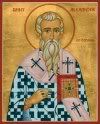
"But the Pharisees said, He casteth out demons through the prince of demons." (Matt 9:34) These words are the height of stupidity, for no demon casts out other demons. But let us suppose that He cast out demons as one who served the prince of demons, that is, as a magician. How then did He heal diseases, forgive sins, and preach the Kingdom? For the demon does just the opposite: he brings on diseases and separates man from God.
Blessed Theophylact
Showing posts with label Blessed Theophylact. Show all posts
Showing posts with label Blessed Theophylact. Show all posts
Sunday, July 15, 2007
The height of stupidity


Monday, January 22, 2007
Zacchaeus was a wee little man
Anyone who is chief among many in wickedness is little in spiritual stature, for the flesh and the spirit are opposites to one another, and for this reason he [Zacchaeus] cannot see Jesus for the crowd. Crowded in by a multitude of passions and worldly affairs, he is not able to see Jesus acting, moving, and walking about. Such a man as this cannot recognize Christian acts for what they are, namely, Christ acting and moving in us. But such a man, who never sees Jesus passing by and cannot perceive Christ in Christian acts, will sometimes change from negligence and come to his senses. Then he will climb up to the top of the sycamore-fig, passing by every pleasure and sweetness, as signified by the figs, and counting them as foolish and dead. Becoming higher than he was and making ascents in his heart, [Ps. 83:6] he is seen by Jesus and can see Jesus, and the Lord says to him, Make haste, and come down, which means, Through repentance you have ascended to a higher life; come down now through humility lest pride and high mindedness make you fall. Make haste, and humble yourself. If you humble yourself, I must abide at your house, for it is necessary that I abide in the house of a humble man. Upon whom shall I look, if not upon him who is humble and meek, who trembles at My words? [Is. 66:2] Such a man gives half of his goods to the destitute demons. For our substance is twofold: flesh and spirit. The righteous man imparts all his fleshly substance to the truly poor, the demons who are destitute of everything good. But he does not let go of his spiritual substance, for as the Lord likewise said to the devil concerning Job, Behold, I give into thine hand all that he has, but touch not his soul. [Job 1:12] And if he has taken any thing from any man by false accusation, he restores it to him fourfold. This suggests that if a man repents and follows a path that is opposite to his former way of wickedness, he heals his former sins through the four virtues, and thus he receives salvation and is called a son of Abraham. Like Abraham, he also goes out of his land and out of his kinship with his former wickedness and out of the house of his father, meaning, he comes out from his old self and rejects his former condition. He himself was the house of his father, the devil. Therefore, when he went out of the house of his father, that is, when he went out of himself and changed, he found salvation, as did Abraham.
Blessed Theophylact
Sunday, November 05, 2006
Of Soils
As He sowed, that is, as He taught, some seed fell along the road. He did not say that the sower threw the seed along the road, but instead that some fell there. Christ the Sower sows and teaches, and His word falls upon his listeners everywhere, and it is they who show themselves to be like a road, or a rock, or thorns, or good soil. When the disciples ask about the parable, the Lord says, Unto you it is given to know the mysteries of the kingdom of God, that is, unto you who desire to learn, for everyone that asketh, receiveth. [Mt. 7:8] To the others who are not worthy of the mysteries, He speaks obscurely. They think that they see, but they do not; they hear, but they do not understand. And this is to their benefit. The Lord hides these things from them so that they will not fall under greater condemnation for understanding the mysteries and then disregarding them. He who understands, and then disregards, deserves a more severe punishment.
Blessed Theophylact
Subscribe to:
Posts (Atom)