Man, in this art, is no longer even a caricature of himself; he is no longer portrayed in the throes of spiritual death, ravaged by the hideous Nihilism of our century that attacks, not just the body and soul, but the very idea and nature of man. No, all this has passed; the crisis is over; man is dead. The new art celebrates the birth of a new species, the creature of the lower depths, subhumanity.
Fr. Seraphim Rose
Sunday, February 05, 2006
"Modern Art" you say?


Saturday, February 04, 2006
The harmony of the Divine Liturgy
…what…is the baptismal formula? [In the name of the Father and the Son and the Holy Spirit] It is essentially no more and no less than an expression of the dogma of the consubstantiality of the Holy Trinity. Thus, everything that precedes the Creed is a preparation for 'attending' to the word 'consubstantiality,' ὁμοούσια. 'Consubstantiality' is precisely 'wisdom.'
The idea behind this order of the liturgy is clear: mutual love alone is the condition of 'unity of thought,' ὁμόνοια, the one thought of those who love one another, in contrast to the external relation to one another which yields nothing more than 'similarity of thought,' ὁμοίνοια, on which secular life is based: science, social life, government, etc. But 'unity of thought' provides the ground that makes possible joint confession ὁμολογήσομεν, i.e., understanding and acknowledgement of the dogma of consubstantiality, ὁμοούσια. In or through this unity of thought, we come into contact with the mystery of the Triune Divinity.
St. Pavel (Florensky)
Friday, February 03, 2006
The ideal society:
We cultivate refinement without extravagance and knowledge without effeminacy…
Thucydidis
Thursday, February 02, 2006
The legitimacy of Orthodoxy
It is not possible to subject faith events to the arid judgment of postmodern scientific research and experimentation. Orthodoxy, as a system of beliefs of faith and principally as a way of life, does not need the faux analyses and research of types of psychology which give the appearance of being scientifically legitimate.
Konstantin Nikolakopoulos
Wednesday, February 01, 2006
Putting the mind to the Cross
The dogma of the Trinity is a cross for human ways of thought. The apophatic ascent is a mounting of calvary. This is the reason why no philosophical speculation has ever succeeded in rising to the mystery of the Holy Trinity. This is the reason why the human spirit was able to receive the full revelation of the Godhead only after Christ on the cross had triumphed over death and over the abyss of hell. This, finally, is the reason why the revelation of the Trinity shines out in the Church as a purely religious gift, as the catholic truth above all other.
Vladimir Lossky
Tuesday, January 31, 2006
The time has come...
High time that we stop deceiving ourselves with examples of the individual piety of many great leaders of our culture and of the beneficence of their works! It were time for us to recognize clearly the controlling idea of the new culture. Individual personalities and their individual accomplishments may indeed be excellent; but, on the whole, our modern culture is nothing but a state of chronical rebellion against God. Without clearly realizing this, it will be impossible to alter the course of culture.
St. Pavel (Florensky)
Monday, January 30, 2006
Agnosticism
It is decidedly wrong, then, to regard the modern Nihilist, in whatever guise he may appear as 'agnostic.' The 'death of God' has not simply happened to him as a kind of cosmic catastrophe, rather he has actively willed it – not directly, to be sure, but equally effectively by preferring something else to the true God.
Fr. Seraphim (Rose)
Sunday, January 29, 2006
s-harmony
Rape, incest, adultery, and sodomy are wrong because they are inconsistent with the harmony and good order of the family, which is the foundation of all social harmony and social order, and thereby of all human happiness.
Harry Jaffa
Friday, January 27, 2006
Episcopal beatification?
Raise your hands if you are perplexed by this:
Episcopalians want Marshall for sainthoodUpdate:Found in another source:
NEW YORK -- Episcopalians from a church where the late Supreme Court Justice Thurgood Marshall worshiped are asking their denomination to name him a saint.
Marshall, who died in 1993, was a towering figure in the civil rights movement and the first black justice to sit on the nation's highest court.
Members of St. Augustine's Church in Washington, D.C., will seek initial approval for the honor Friday from delegates to the convention of the Episcopal Diocese of Washington.
''His Christian faith was deep inside his being and it was this faith which was the foundation and source of his energetic pursuit of justice,'' said the Rev. Thomas Smith.
Among other contemporary Episcopal saints are the Rev. Martin Luther King Jr. and Florence Nightingale.
AP
If approved, Marshall's feast day would be celebrated on May 17, commemorating his 1954 victory against school segregation in Brown vs. Board of Education, a case he argued as an attorney before the Supreme Court. If the process is completed successfully, his feast day will be celebrated in May 2010, following the national convention in June 2009.Now this is just getting psycho...
The chronic of our culture
High time that we stop deceiving ourselves with examples of the individual piety of many great leaders of our culture and of the beneficence of their works! It were time for us to recognize clearly the controlling idea of the new culture. Individual personalities and their individual accomplishments may indeed be excellent; but, on the whole, our modern culture is nothing but a state of chronical rebellion against God. Without clearly realizing this, it will be impossible to alter the course of culture.
St. Pavel (Florensky)
Thursday, January 26, 2006

Wednesday, January 25, 2006
'That they all may be one' in that multifarious way?
That John 17 [v. 21 “That they all may be one”] can be applied to Churches which have not the slightest understanding of glorification (theosis) and how to arrive at this cure in this life is very interesting, to say the least. … In John 17 Christ prays for the cure of the glorification of His disciples and their disciples, not for divided Churches, indeed not for traditions which have not the slightest idea of what the cure of glorification is.
Fr. John Romanides
Tuesday, January 24, 2006
The 'thingness' of a person
In a manner of speaking follows St. Pavel on Love parts I,(II is an accidental repost of I) III, IV, V, VI and VII
The modern, illusionistic understanding of life is dominated by the psychological interpretation of love…This new understanding starts, it appears, with Leibniz…For Leibniz, “monads have neither windows nor doors” through which real interaction in love would occur. Therefore, doomed to the self-enclosedness of ontological egotism and purely internal states, they love only illusorily, not going out of themselves through love. …
According to this definition, “love is a rejoicing in the happiness of another or others, considered also as one’s own happiness.” [cf. the "social gospel", etc.] …“Charity is universal good will, and good will is a state of love or estimation.” …for Spinoza, the essence of our soul lies in knowledge and…he calls the soul mens, which, strictly speaking, means mind, thought. “Love is pleasure accompanied by the idea of an external cause” [“The soul is a thinking thing (res cogitans)”] ...For Leibniz and his followers, love, as we have seen, is conditioned by the idea of the happiness of another. For Spinoza, “the idea of an external cause,” i.e., the idea of some not-I, only accompanies enjoyment as a purely subjective state of I. But in both conceptions, love is interpreted exclusively psychologically and thus is deprived of its significance as a value. Love can even be considered undesirable. If love does not lead anywhere metaphysically, if it does not really connect anyone with anyone else, if it is not ontological but only psychological, why should we then see in it anything more valuable than a mere titillation of the soul? Being a source of false ideas about the interaction of that which exists, love turns out to be false and harmful. For the psychological understanding, love is the same thing as desire. Here, this confusion is not at all an accidental and secondary feature of rationalistic essential principles of this understanding of life. For love is directed toward a person, whereas desire is directed toward a thing. But the rationalistic understanding of life does not distinguish, and is not able to distinguish, between a person and a thing. More precisely, it has only one category, the category of thingness, and therefore all things, including persons, are reified by this understanding, are taken as a thing, as res.
St. Pavel (Florensky)
Something for the "patriots" to remember
I have always feared the temptation of the anti-Christ hidden in an uncontrolled nationalism.
Fr. Roman Braga
Monday, January 23, 2006
Through the eyes of the great ape
If the Revolutionary goal "beyond Nihilism" is described in precisely contrary terms, and if Nihilists actually see it as a reign of "love," "peace," and "brotherhood," that is because Satan is the ape of God and even in denial must acknowledge the source of that denial, and--more to the present point--because men have been so changed by the practice of the Nihilist "virtues," and by acceptance of the Nihilist transformation of the world, that they actually begin to live in the Revolutionary Kingdom and to see everything as Satan sees it, as the contrary of what it is in the eyes of God.
Fr. Seraphim (Rose)
Saturday, January 21, 2006
Orthodoxy...
...We see from all this that we teach conformably with Holy Scripture, and the holy Fathers, and Teachers, nothing changing or misrepresenting in the dogmas handed down to us, nothing adding to them, or taking from them, and adding nothing new.
St. Mark of Ephesus
Friday, January 20, 2006
Apropos to the "Afterfeast" of St. Mark of Ephesus
The Patriarch also had an interview with Mark, and entreated him in the name of all the Saints, and for the sake of his father's memory, to agree to the union with the Church of Rome. But this venerable man remained firm against all entreaties. He had already been asked to agree to union, even if it were apparently for the sake of others. His answer was: "In deeds of faith there must be no concessions, no waverings." And when the difference between the two confessions was shown as insignificant, Mark answered: "You speak just like the prefect, who entreated Theodorus to receive heretics into communion only once, and then to act as he liked." The saint answered: "Thy request is like, as if a person said, Allow me to cut your head off, and then you may go wherever you like." Following up this example, Mark remained firm to the end.
Thursday, January 19, 2006
Apropos to the feast of St. Mark of Ephesus
From the interview of St. Mark with Pope Eugenius:
The Councils of the Church have condemned as rebels those who have transgressed against some dogma and have preached thus and fought for this, for which reason also they are called 'heretics'; and from the beginning the Church has condemned the heresy itself, and only then has it condemned the leaders of the heresy and its defenders. But I have by no means preached my own teaching, nor have I introduced anything new in the Church, nor defended any foreign and false doctrine; but I have held only that teaching which the Church received in perfect form from our Saviour, and in which it has steadfastly remained to this day: the teaching which the Holy Church of Rome, before the schism that occurred between us, possessed no less than our Eastern Church; the teaching which, as holy, you formerly were wont to praise, and often at this very Council you mentioned with respect and honor, and which no one could reproach or dispute. And if I hold it and do not allow myself to depart from it, what Council will subject me to the interdiction to which heretics are subject? What sound and pious mind will act thus with me? For first of all one must condemn the teaching which I hold; but if you acknowledge it as pious and Orthodox, then why am I deserving of punishment?

Wednesday, January 18, 2006
The blind world swings...
Even though written by a total nihilist so true, so true...
The Devil's Swing
Beneath a shaggy fir tree,
Above a noisy stream
The devil's swing is swinging,
Pushed by his hairy hand.
He swings the swing while laughing,
Swing high, swing low,
Swing high, swing low,
The board is bent and creaking,
The rope is taut and chafing
Against a heavy branch.
The swaying board is rushing
With long and drawn-out creaks;
With hand on hip, the devil
Is laughing with a wheeze.
I clutch, I swoon, I'm swinging.
Swing high, swing low,
Swing high, swing low,
I'm clinging and I'm dangling,
And from the devil trying
To turn my languid gaze.
Above the dusky fir tree
The screeching throng whirls round:
"You're caught upon the swings, love,
The devil take you, swing!"
The devil will not slacken
The swift board's pace, I know,
Until his hand unseats me
With a ferocious blow.
Until the jute, while twisting,
Is frayed through till it breaks,
Until my ground beneath me
Turns upward to my face.
I'll fly above the fir tree
And fall flat on the ground.
So swing the swing, you devil,
Go higher, higher...oh!
Fyodor Sologub
Tuesday, January 17, 2006
Worldly Wisdom
All worldly wisdom which is guided only by the physical senses, without regard for the Holy Spirit, is insanity before God and before God's angels; for such a wisdom does not perceive either the spirit or the purpose of this world; rather it knows this world only as ashes from without and ashes from within; as ashes which the wind of chance piles up and strews at one moment this way and at another moment that way.
All wisdom of man which is directed only by the senses and by physical conceptions and fantasies is insanity before God and before angels and saints of God, for it does not know man as man; that is, as a spiritual being related to God, rather it knows man only as a body from without and as a body from within; as a body according to form and as a body according to essence.
St. Nikolaj Velimirovic
…true human wisdom, true human prudence is insufficient just because it is human. At the same time, the mental innocence of 'babes,' the absence of mental riches which prevent one from entering the Kingdom of Heaven, can turn out to be a condition for the acquisition of spiritual knowledge, which exhaust the poor wise men, are in vain. Like ungainly camels, they are loaded down with their knowledge. And like salt water, science only inflames the thirst for knowledge. It never gives peace to the feverish mind. For the Lord's 'easy yoke' and 'light burden' (Matt. 11:30) give the mind what it cannot get from the cruel yoke and hard, unbearable burden of science.
St. Pavel (Florensky)
Monday, January 16, 2006

Sunday, January 15, 2006
Christian Culture
Christians proved that it was possible to re-orient the cultural process, without lapsing into a pre-cultural state, to re-shape the cultural fabric in a new spirit. The same process which has been variously described as a "Hellenization of Christianity" can be construed rather as a "Christianization of Hellenism." Hellenism was, as it were, dissected by the Sword of the Spirit, was polarized and divided, and a "Christian Hellenism" was created.
Fr. Georges Florovsky
Saturday, January 14, 2006
Love part VIII
Follows Love part VII
Rising above the bounds of its nature, I goes out of temporal-spatial limitedness and enters into Eternity. There the whole process of the interrelations of the lovers is a single act, in which an infinite series of individual moments of love is synthesized. This single, eternal, and infinite act is the consubstantiality of the lovers in God, where I is one and the same as the other I, but also different. Every I is not-I, i.e., Thou, by virtue of the renunciation of oneself for the sake of another. And it is I by virtue of the renunciation of the other I for the sake of the first. Instead of individual, separate, self-assertive I's, we get a dyad, a di-unitary being that has the principle of its unity in God: "finis amoris, ut duo unum fiant" ("the limit of love: two are one"). Furthermore, every I sees in the Divine image of another I its own Divine image as in a mirror.
St. Pavel (Florensky)
On "good works"
If someone were to say that he does good and humane works outside of Christ, you know that those, his works, are spoiled to the core and are corroded, be it from vanity or be it from hidden selfishness. Man, without Christ, is the same as branches without the vine. He Himself told us this. The vine is hidden and unseen, but the branches are seen. Nevertheless, the grapes on the branch and the branch itself depends on the vine. The vine of all-encompassing good grows from the heart of God the Father and is watered by the sweetness of the Holy Spirit.
St. Nikolaj Velimirovic
If there is truth, there is inevitably love. … Love follows from the knowledge of God with the same necessity as light radiates from a lamp or nocturnal fragrance emanates from the open calyx of a flower: "knowledge becomes love he gnosis agape ginetai." Therefore, the mutual love of Christ's disciples is the sign of their learning, their knowledge, their walking in the truth. Love is the characteristic sign by which a disciple of Christ is recognized…
But one cannot make a greater error than to identify the spiritual love of one who knows the Truth with altruistic emotions and the striving for the "good of mankind," a striving that, at best, is grounded in natural sympathy or in abstract ideas. For "love" in this sense, which we call "Judaic," everything begins and ends in empirical works, the value of which is determined by their visible effect. But for spiritual love, or love in the Christian sense, this value is only tinsel. Even moral activity (philanthropy and so on) is, taken in itself, an absolute zero. What is desirable is not the outward appearance, not the "skin," of special activities, but life full of grace, which overflows in every creative act of a person. But "skin" as "skin," the empirical outward appearance as such, can always be falsified. No age dares to deny that there are "false apostles, deceitful workers, transforming themselves into the apostles of Christ," that even "Satan himself is transformed into an angel of light" (2 Cor. 11 13-14).
St. Pavel (Florensky)
Friday, January 13, 2006
The 'relevancy' of the Church
No, it is not the insufficiency of life in the Church which must be spoken of, but of the insufficiency of Church consciousness in us. … Unfortunately, we ourselves do not value our Church and the great blessing of Church life enough. We do not confess our faith in the Church bravely, clearly, and definitely. While believing in the Church, we constantly seem to pardon ourselves for the fact that we still believe in it.
St. Hilarion (Troitsky)
Thursday, January 12, 2006

On the misinterpretation of Holy Writ
When, however, sociologist or ethicists, without having the Holy Spirit, study the works of the Fathers, they divide and separate them. And I think that this isolated, detached use of quotations from the Fathers-out of the ascetic spirit-in order to support our impure and human-centered thoughts is the greatest heresy. When we take the Fathers out of the spirit of asceticism, of repentance, we divide them. And every division is a change for the worse. All of the heretics did the same. They used the passages without understanding them, without having the prerequisites of interpreting them correctly. We should therefore carry out the "watchword" which prevails in our times - "return to the Fathers" - not only by studying the texts of the Fathers but also by making the effort of acquiring the life of the Fathers. We should live in the holy Church, live with the holy Mysteries and the holy virtues, stop being individuals and start living like persons, as worthy members of Christ.
Metropolitan Hierotheos (Vlachos)
Wednesday, January 11, 2006
Another step up for sodomy.
"Only now are media and entertainment brands being created for the gay and lesbian audience following the success of brands for other minorities," said founder Matt Farber about the creation of "Music with a Twist" which will be dedicated to "nurturing lesbian, gay, bisexual and transgender artists." Notice how he refers to sodomites as a 'minority' as if this perversion is, obviously, as inherent as skin color.
The label also plans to release various compilations geared toward gay and bisexual audiences, featuring hit songs by established artists that have been embraced by gay, bisexual and transgender audiences, as well as tracks from emerging gay artists.What happens when this label embraces a song from an artist that has nothing to do with sodomy, will they succumb? Oh, wait, I forgot we're talking about the entertainment industry...there are no such artists...
Distinctions
All friendship, all society, indeed all of human existence, arises from the physical difference of male and female human beings. From this physical difference arises the ground and purpose of human life, because it is the ground and purpose of nature. …The distinction between a man and a woman is a distinction as fundamental as any in nature, because it is the very distinction by which nature itself is constituted. It is the ability of two members of the same species to generate a third, that confirms them as members of the same species. It thereby confirms male and female members of the human species in that equality of rights to which they are entitled as members of that species.
Harry Jaffa
Tuesday, January 10, 2006
Love part VII
Follows Love part VI
It is not the case that love of one's brother is the content of the Truth as the Tolstoyans and suchlike religious nihilists affirm. It is not the case that this love of one's brother exhausts everything. Absolutely not. Love of one's brother is a revelation to another, a passage to another, the inflow into another of that entering into Divine life which in the God-communing subject is perceived by this subject as knowledge of the Truth. The metaphysical nature of love lies in the supralogical overcoming of the naked self-identity "I = I" and in the going out of oneself. And this happens when the power of God's love flows out into another person and tears apart in him the bonds of finite human selfhood. Owing to this going out of itself, I becomes in another, in not-I, this not-I. I becomes consubstantial with the brother, consubstantial (homoousios) and not only like-substantial (homoiousios). And it is this like-substantiality that constitutes moralism, i.e., a vain, inwardly insane attempt at a human, extra-Divine love.
St. Pavel (Florensky)
Monday, January 09, 2006
The most successful country?
What these editorial writers fail to realize is that the writer who emphasizes spiritual values is very likely to take the darkest view of all of what he sees in this country today. For him, the fact that we are the most powerful and the wealthiest nation in the world doesn't mean a thing in any positive sense. The sharper the light of faith, the more glaring are apt to be the distortions the writer sees in the life around him.
Flannery O'Conner
Saturday, January 07, 2006
Who will be man's next King?
The God hitherto so real and so present to Christian men cannot be disposed of overnight; so absolute a monarch can have no immediate successor. So it is that, at the present moment of man's spiritual history--a moment, admittedly, of crisis and transition--a dead God, a great void, stands at the center of man's faith.
Fr. Seraphim (Rose)
Thursday, January 05, 2006
Love part VI
Follows Love part V
Love of another person is the reflection of true knowledge upon this person, while knowledge is revelation of the Trihypostatic Truth to the heart, i.e., the abiding in the soul of God's love of man: "If we love one another, God dwelleth in us, and his love is perfected in us" (1 John 4:12). We thus enter with Him not only into an impersonal, providential-cosmic relationship, but also into a personal father-son communion.
St. Pavel (Florensky)
But the LORD is in his holy temple: let all the earth keep silence before him.
As usual my trip to Salvation Army yielded precious results. Today I found a book entitled Creative Ways to Worship (I just knew I had to buy it with a title like that-to add to my vast collection of heretical books). The first chapter Silent Service takes its inspiration from the above verse.
The minister leads the service by use of postures, gestures, and movements. This necessitates careful study of the verbs in the liturgy. The congregation will follow the service the best they can, creating their own gestures and movements from cues supplied by the leader. Interpretive pantomime artists may be used to help the congregation. The congregation creates their own sermon from the gesture suggestions and cue cards of the minister.I ask, what happens to those poor people that can't follow along? It's worse than being at a Mass in 1963... What type of sermon will this be you ask? "A sermon, for example, based on 1 John 4:8 entitled 'God Is Love,' might have these words on three pieces of construction paper. To these could be added a question mark on blue paper, an exclamation point on pink, a war or violence-scene poster, and finally, a crucifix." But the excitement comes in when it comes to the "Lord's Supper":
A tablecloth, preferably red and white checked is spread on the altar table. Assigned member of the congregation bring forward the loaf and bottle of grape juice or communion wine. It is poured audibly into one chalice. All the congregation gather in a large circle about the table.Is it just me or does this 'gathering' remind anyone else of a certain gathering in remote Albania?

Wednesday, January 04, 2006
The 'foundation' for modern 'ecumenism'?
Following are excerpts from letters between Patriarch Jeremias II and the Tübingen "theologians" which constituted an introduction to a book review in a certain publication.
Now to clear up the false impression that this excerpt gives. It should be obvious that the "ecumenism" spoken of was a failure as the Tübingen "theologians" went on being their Lutheran selves. Here is another quote from the so-called "theologians": "If they [the Orthodox] wish to take thought for the eternal salvation of their souls, they must join us and embrace our teaching, or else perish eternally!" Finally after three letters and three rebukes of the "theologians" teaching Patriarch Jeremias asked them not to try and pawn off their beliefs: "Go your own way, and do not write any more on doctrinal matters; and if you do write, then write only for friendship's sake." Going a little deeper into the matter we learn that the whole correspondence was a set up, if you will.
"We received the letters which your love sent us and the booklet which contains the articles of your faith. We accept your love, and in compliance with your request we shall endeavor to clear the issues in which we agree and those in which we disagree" (Patriarch Jeremias II of Constantinople to the Tübingen theologians, writing on the Augsburg Confession in May 1576).Described by the author of the book review as "remarkable correspondence" and "unmistakable evidence that true Christian ecumenism is a centuries-old project."
"We ask your holiness to accept our reply with a glad countenance and a gentle spirit, to read it attentively and carefully…to scrutinize it commensurate with your own piety and wisdom in these great matters. We will piously and peacefully discuss the articles in dispute" (from the theologians' reply to the patriarch).
Now to clear up the false impression that this excerpt gives. It should be obvious that the "ecumenism" spoken of was a failure as the Tübingen "theologians" went on being their Lutheran selves. Here is another quote from the so-called "theologians": "If they [the Orthodox] wish to take thought for the eternal salvation of their souls, they must join us and embrace our teaching, or else perish eternally!" Finally after three letters and three rebukes of the "theologians" teaching Patriarch Jeremias asked them not to try and pawn off their beliefs: "Go your own way, and do not write any more on doctrinal matters; and if you do write, then write only for friendship's sake." Going a little deeper into the matter we learn that the whole correspondence was a set up, if you will.
The preface [to the Greek translation of the Augsburg Confession] is surely a red herring, serving to camouflage the real purpose of the enterprise. It is not a 'simple' translation; nor is it intended for intra-ecclesiastical purpose in Germany. The author is in fact adding much of his own..... The document is clearly an ecumenical overture to readers who are unfamiliar with the religious developments of sixteenth-century Germany. -Jorgensen, Augustana GraecaIf this didn't reveal to you the pompousness of said "theologians" maybe this quote from the horses mouth will:
As far as we know, we have both embraced and preserved the faith which has been handed down [to us] by the holy apostles and prophets, the God-bearing fathers and patriarchs, and the seven [ecumenical] synods that were built upon the God-given scriptures.Mr. "Theologian" evidently didn't realize that he was holding correspondence with one of said patriarchs... In Patriarch Jeremias' replies he emphasized that no one, even the enlightened "theologians" had a right to innovate...Patriarch Jeremias: "We reiterate these matters again, although we have been well-informed by your letters that you will never be able to agree with us or rather, we should say, with the truth."
we request that from henceforth you do not cause us more grief, nor write to us on the same subject if you should wish to treat these luminaries and theologians of the Church in a different manner. You honor and exalt them in words, but you reject them in deeds. For you try to prove our weapons which are their holy and divine discourses as unsuitable. And it is with these documents that we would have to write and contradict you. Thus, as for you, please release us from these cares.And yet the bombastic pompousness continues:
And even if you ask us to no longer trouble you with such writings (although we have conversed with you with much love and much kindness and with due respect) yet we are hopeful that the matters which have been written to you by us up to now will in time be re-examined and reconsidered more accurately and much better. ... Therefore, standing together with Your Holiness, Patriarch and Most Reverent Sir, we offer to the God of all, our true friendship which we have shown to you and which we will continuously afterwards keep.When do the "theologians" learn? and when will people learn that the only 'ecumenism' is entering into the One Holy Catholic and Apostolic Church?
Love part V
Follows Love part IV
Only one who has come to know the Triune God can love with a true love. If I have not come to know God, have not come to commune with His Being, I do not love. And contrarily, if I love, I commune with God, know Him. But if I do not love, I do not commune with Him and do not know Him. There is a direct relationship between knowledge and love for creatures here. The center from which this knowledge and this love proceed is my abiding in God and God's abiding in me.
St. Pavel (Florensky)
Tuesday, January 03, 2006
120 million owners of the Book of Mormon testify...
''Of course we're Christian. The very name of the church declares that,'' said [President] Gordon B. Hinckley
Just put "Christian" in your name and you're saved? That's much easier than filling out the back of some Chik track and sending it in...
Just put "Christian" in your name and you're saved? That's much easier than filling out the back of some Chik track and sending it in...
O Great Mystery
The mystery of the Trinity only becomes accessible to that ignorance which rises above all that can be contained within the concepts of the philosophers.
Vladimir Lossky
Monday, January 02, 2006
Love part IV
Follows Love part III
Man's knowledge of God is inevitably revealed and manifests itself as active love for creatures, a love that is already given to me in immediate experience. And manifested love for creatures is contemplated objectively as beauty. Whence the pleasure, the rejoicing, the consolation in love during its contemplation. That which makes one rejoice is called beauty; love as an object of contemplation is beauty.
St. Pavel (Florensky)
Sunday, January 01, 2006
The rightful suppression of heresy
...if any treatise composed by Arius should be discovered, let it be consigned to the flames, in order that not only his depraved doctrine may be suppressed, but also that no memorial of him may be by any means left. This therefore I decree, that if any one shall be detected in concealing a book compiled by Arius, and shall not instantly bring it forward and burn it, the penalty for this offense shall be death; for immediately after conviction the criminal shall suffer capital punishment.
St. Constantine the Great
Saturday, December 31, 2005

Friday, December 30, 2005
Небесно царство
So I watched Kingdom of Heaven last night... The first I knew of this movie was when I saw a poster in Russia...so I thought it was a Russian movie, especially with a title like "Kingdom of Heaven"; as usually when I see the Russian words "kingdom" and "heaven" it's in liturgical texts... But i digress from the scathing review... Going into the movie all that I knew was that it was about the Frankish crusades. From the get-go I learned that one went to Jerusalem to find forgiveness (through bloodshed) which Orlando's character desperately needed as he had just killed a priest for insulting his dead wife... [You can see the obvious failure of the Frankish itemization of sins and their following penances.] Throughout the movie we learn that the (good) main characters are more about 'spirituality' than 'religion'...In the words of my brother, "I didn't know they were such liberal thinkers..." As usual the portrayal of Islam is a conciliatory one; it comes out (over all) as truly peace-loving and merciful. Saladin in the end allows Jerusalem to surrender and all its occupants to be peacefully escorted to the sea. We read from history the true account:
Saladin had taken counsel and laid down these ransom terms for the inhabitants of Jerusalem: each male, ten years old and over, was to pay ten besants for his ransom; females, five besants; boys, seven years old and under, one. Those who wished would be freed on these terms and could leave securely with their possessions. The inhabitants of Jerusalem who would not accept these terms, or those who did not have ten besants, were to become booty, to be slain by the army's swords.On the second disk of the movie there were several tv segments-one from the history channel and one from A & E. The history channel segment examined what was "history" and what was "hollywood". This cleared up the gist of the story (even with their annoying presentation). However, here are some gems from the A & E movie reel: [the crusades were] "about being bloodthirsty and not being tolerant at all" - Eva Green, co-star; from the narrator:
"Crusaders were the hero's of medieval Europe; but for modern audiences the crusades are far from a noble endeavor. For us they exemplify intolerance not virtue. [the movie is] about the triumph of dialogue over war, about the possibility for peace even in the most divided land. Ultimately it is a film that asks us to look to the distant past in order to imagine a different future."From this I learned that intolerance is the opposite of nobility and virtue and tolerance is the highest virtue...hmm...lets have a word now from G.K. Chesterton: "Tolerance is the virtue of a man without convictions." We move through tolerance to the social gospel: "…the story of…men whose faith was tempered with tolerance. Noble men who sought a kingdom of heaven here on earth." What I find strange about both of these segments was that there were only about four instances when they talked about any Muslim aggression. The Islamic prerogative to kill infidels was never mentioned whereas the "Christian" prerogative was throughout. So in the end I liked it...because it gives me something to rant about.
Thursday, December 29, 2005
To clarify your history books
[Ecumenical] Councils were convened by the Roman Emperor, beginning with Constantine the Great, in coordination with the Roman Patriarchates of Elder Rome, New Rome, Alexandria, Antioch and finally Jerusalem by 451. These Councils are (1) Nicea 325, (2) Constantinople 381, (3) Ephesus 431, (4) Chalcedon 451, (5) Constantinople 553, (6) Constantinople 680, (7) Nicea 786/7, (8) Constantinople 879 and (9) Constantinople 1341. We have here Eight Ecumenical Councils which were promulgated as Roman Law by the signature of the Emperor after their minutes had been signed by the Five Roman Patriarchates and their Metropolitans and bishops. Then we have the Ninth Ecumenical Council of 1341, whose minutes were signed by only Four Roman Patriarchates and countersigned by the Roman Emperor. Gone was now the Patriarchate of Elder Rome which had been forcefully captured by the Franks, Lombards, Germans and with the help of the Normans. This struggle began in intensity in 983 and was consummated in 1009-1046. After 1045 the Popes of Rome, except for Benedict X (1058-9), were no longer Romans, but members of the Franco-Latin nobility who enslaved the Roman population.
Fr. John Romanides
A slave to Sodom
The traditional family, the embodiment and expression of "the laws of nature and of nature's God," as the foundation of a free society, has become merely one of many "alternative lifestyles." But then a free society, as distinguished from a despotic one, itself becomes merely one of many "alternative lifestyles." A free people who succumbs to such a teaching cannot long endure. Those who choose sodomy are already choosing slavery, because whoever is an indiscriminate slave to his own unresisting passions will sooner or later become a slave to the passions of others.
Harry Jaffa
Wednesday, December 28, 2005
Love part III
Follows Love part II
Persons who are not yet pure, persons insofar as they are thinglike, fleshly, are capable of falling into the “similarity” of desire. But insofar as they are pure and have detached themselves from “thingness,” they are capable of achieving the “identification” of love.
But what is this thingness of a person? It is the vacuous self-equality of the person, giving to the person the unity of a concept that is self-confined in the combination of its attributes, i.e., the unity of a dead, fixed concept. In other words, it is nothing but the rationalistic “comprehensibility” of a person, i.e., the subordination of a person to the rationalistic law of identity. On the contrary the personal character of a person, this living unity of his self-building activity, the creative transcending of his self-enclosedness, constitutes his nonsubsumability in any concept, his “incomprehensibility,” and therefore his unacceptability for rationalism. It is the victory over the law of identity that raises a person above a lifeless thing and makes him a living center of activity. But it is clear that activity is essentially incomprehensible for rationalism, for activity is creativity, i.e., the addition to the given of that which is not yet given, and thus the overcoming of the law of identity.
St. Pavel (Florensky)

Saturday, December 24, 2005
Apropos to the Nativity Feast
"Spiritual light," sometimes combined with spiritual "warmth" and "fragrance," is in fact the reasonable intuition we have been seeking, the intuition that includes the series of its own groundings. It is perfect beauty as the synthesis of absolute concrete givenness and absolute reasonable justifiedness. Spiritual light is the light of the Trihypostatic Divinity Itself, the Divine essence, which is not only given, but also self-given. Spiritual light is the "light of reason," the light that started to shine for the world at the Birth of our Lord Jesus Christ, as is sung in the Christmas troparion:
Thy birth, O Christ our God,
has shed upon the world the light of reason …
Spiritual light is the "Light of Christ" that illuminates everyone." Spiritual light is the "mental light" that makes "the soul vigilant before Thee," God, as the Holy Church tells us. It is the light of God's love, about which we pray:
With love illuminate me, I pray
that I may see Thee, Word of God
Spiritual light is the light whose seeing constitutes the contemplation of God and therefore our salvation, the salvation of us who cannot be without God. Does not the Orthodox believer pray: "Save me with Thy illumination"?
St. Pavel (Florensky)
Christ Is Born!
Thursday, December 22, 2005
Rogue married Frankish priests...and the cure for the die hard ethnic "Catholic"
...these "priests without borders" provide a controversial remedy for the growing deficit of clerics in Catholic pulpits nationwide, albeit one decidedly not endorsed by the Catholic Church itself. ...more than 50,000 people have been served by the priests..."fallen" Catholics who haven't attended church for years, but want a Catholic baptism for their child or a Catholic wedding. Still others are divorced but want to wed again, even though their first marriage has not been annulled, as the church requires. Some want a religious service even though they are marrying non-Catholics, while others want to wed in locations not sanctioned for the ceremony, such as the beach or at home. And others have simply lost faith in the establishment church, judging it too hide-bound and conservative.I just can't understand what the point of a "Catholic" service is if it's not performed by the "church" or in the "church". I guess it fits some people's "traditional" needs and that "symbolism means alot"...

Wednesday, December 21, 2005
Love part II
Follows Love part I
…love is a substantial act, going from the subject to the object and having support in the object, whereas knowledge and joy are directed toward the subject, and the subject is the point of application of their force. God's love goes over to us, but knowledge and contemplative joy abide in Him. For this reason it is not the Hypostasis of the Father or the Hypostasis of the Holy Spirit (Paraclete = Comforter, Giver of Joy) that became incarnate, but the Son-Word, the hypostatic Divine Love…
St. Pavel (Florensky)
Love part I
…love is a substantial act, going from the subject to the object and having support in the object, whereas knowledge and joy are directed toward the subject, and the subject is the point of application of their force. God's love goes over to us, but knowledge and contemplative joy abide in Him. For this reason it is not the Hypostasis of the Father or the Hypostasis of the Holy Spirit (Paraclete = Comforter, Giver of Joy) that became incarnate, but the Son-Word, the hypostatic Divine Love…
St. Pavel (Florensky)
Tuesday, December 20, 2005

Monday, December 19, 2005
What if...
What if there were a religious philosophy that does not presume to declare universal religious truths? The meaning of your existence would be yours to determine.Let me remind you, my dear reader, of the definitions of terms used in this asinine statement:
re·li·gious
1. Having or showing belief in and reverence for God or a deity.
2. Of, concerned with, or teaching religion: a religious text.
3. Extremely scrupulous or conscientious: religious devotion to duty.
phi·los·o·phy
1. Love and pursuit of wisdom by intellectual means and moral self-discipline.
2. Investigation of the nature, causes, or principles of reality, knowledge, or values, based on logical reasoning rather than empirical methods.
3. A system of thought based on or involving such inquiry: the philosophy of Hume.
4. The critical analysis of fundamental assumptions or beliefs.
5. The disciplines presented in university curriculums of science and the liberal arts, except medicine, law, and theology.
6. The discipline comprising logic, ethics, aesthetics, metaphysics, and epistemology.
7. A set of ideas or beliefs relating to a particular field or activity; an underlying theory: an original philosophy of advertising.
8. A system of values by which one lives: has an unusual philosophy of life.
Sunday, December 18, 2005
Like a broken record...
He had always disliked the people who encored a favourite air in the opera-"That just spoils it" had been his comment. But this now appeared to him as a principle of far wider application and deeper moment. This itch to have things over again, as if life were a film that could be unrolled twice or even made to work backwards … was it possibly the root of all evil? No: of course the love of money was called that. But money itself-perhaps one valued it chiefly as a defence against chance, a security for being able to have things over again, a means of arresting the unrolling of the film.
Ransom - Perelandra
Friday, December 16, 2005

Is your job worth the lie?
Teacher recants 'Santa is myth' story ... She told the students that in fact she had heard from Santa, and he wanted to reassure them that he is alive and well in the spirit of Christmas ... Tresia Eaves, whose son goes to the school involved, Richland Elementary, said teachers shouldn't touch the subject of Santa. "My son still believes, and by God he should be able to," she told the Morning News. "Reality comes soon enough."
I don't think that God would want someone to believe in a fake materialistic tycoon like Santa...
The fundamentals of agreed ecclesiology
…we cannot conceive how agreement can be made possible between two conceptions which agree that the existence of the ministry of the Church is by the will of Christ, but differ as to whether that ministry was instituted by Christ Himself in its three degrees of bishop, priest, and deacon. In the same way we judge there to be no practical value in an agreed formula as to the necessity of the sacraments in the Church, when there is a fundamental difference between the Churches not only in regard to their number but also as to their particular efforts. ... Nor can we here apply that principle of economy which in the past the Orthodox Church has applied under quite other circumstances in the case of those who came to her with a view to union with her.
Declaration On Behalf Of The Eastern Orthodox Church - Lausanne, 1927
Thursday, December 15, 2005
…love is not an attribute of God…
…For then God's love would depend on conditional being and would thus be accidental…God, or the Truth, not only has love but, above all, "God is love"…That is, love is God's essence, His own nature, and not only His providential relationship, which is proper to Him. In other words, "God is love" (more precisely, He is "Love"), and not only "the Loving One," even if the "perfectly Loving One."
St. Pavel (Florensky)
Wednesday, December 14, 2005
‘Difficult’ children to be taught needlework
The Arkhangelsk regional public organization ‘Rassvet’ (‘Dawn’) works in the framework of the ‘Street Children’ project to help children from unsuccessful families. On the initiative of this organization, some teenage girls will attend a needlework club at the Church of the Holy Trinity in Arkhangelsk lead by a female parishioner. Pupils of Sunday school of the church attend the club. The children are taught the needlework and make items for charity fairs that are regularly held by the parish.
There is nothing greater than for difficult young ladies to be restored to their feminine selves...and what better way than through needlework? I would also support dishwashing, clothes laundering, cooking, house cleaning, child rearing, etc.
Of demons and dignities
Russian Archbishop Calls Lord Krishna an "Evil demon" ... Dr. Girdhari Bhan: "Archbishop Nikon should have considered the peaceful history of Hinduism before making such atrocious statements that will surely be rejected by people of common sense and dignity."
If calling a pagan god an "evil demon" goes against common sense and dignity then you can just call me non-sensical and un-dignified...
Dr. Balasubramaniam said, "I strongly condemn the outrageous and shameful behavior of the Archbishop of the Russian Orthodox Church in denigrating the oldest religion in the world..."I'm tired of people calling Hinduism the "oldest religion" because we all know that Christianity was founded in Paradise...but on the other hand it's true because Christianity is the "cure for the sickness of religion" as Fr. John Romanides says.
Monday, December 12, 2005
And the story rages on...
Southland Christian Church senior minister Jon Weece yesterday lashed out at the media, the devil and "a handful of misguided and jealous Christians" for second-guessing his congregation's decision to close its doors on Christmas Sunday.
Yesterday, standing on a stage decorated with 15 artificial Christmas trees, Weece downplayed the significance of the day many Christians consider holy. ..."Christmas began as a pagan holiday to the Roman gods, and if we were to really celebrate the historical birth of Jesus, it would either be in early January or mid-April," Weece said. "I'm only pointing out the historical technicalities not out of intellectual arrogance, but again because of the illogical, ill-informed and even hypocritical arguments that were aimed at me this past week."
He went on to say, "Just like these artificial trees behind me Christmas is a fake holiday forced upon us by the Pope and his minions."
Referring to Christianity's Jewish roots, he said that Sunday begins at sundown on Saturday according to biblical tradition.
And with that he lays down the Jewish tradition card...we like to pick and choose Jewish traditions that fit our needs...
Weece noted that Jesus was also criticized for breaking tradition. "There were some whose zeal even in the days of Jesus was misguided," he said. "They emphasized religion over relationship."...and your relationship with your family ("I've watched too many ministers in my life sacrifice their families on the altar of ministry, and ego and pride ...") is MUCH more important than your relationship with Jesus...forget about that little verse Luke 14:26...ah, yes...Jesus criticized for breaking tradition...the "What Jesus Did" card...He's playing his hand well!
Rx for nihilism
Nihilism is, most profoundly, a spiritual disorder, and it can be overcome only by spiritual means; and there has been no attempt whatever in the contemporary world to apply such means.
Fr. Seraphim (Rose)
Sunday, December 11, 2005
That dang pernicious atheism
There are many kinds of atheism, but the worst is the so-called rational faith. It is the worst, for, besides the rejection of the object of faith ("things not seen" [Heb. 11:1]), it is hypocritical, accepts God but rejects His very essence, His "invisibility," i.e., His suprarationality.
St. Pavel (Florensky)
Saturday, December 10, 2005
Friday, December 09, 2005
A spirit yes...but who's spirit?
Add a unique new Spirit to your pre-New Years Eve celebrations by attending or creating a World Spirituality Day event. ...Think of World Spirituality Day as The Earth Day for the Spirit. ...World Spirituality Day also promises to expand into a boundless kaleidoscope of worldwide gatherings and events...The simple purpose of World Spirituality Day is to supercharge your New Year’s transition, celebrations and resolutions with the deepest power of your own spirituality.
They at first appear to be encouraging "spirituality" of any sort ("boundless kaleidoscope") in a 'spirit' of tolerance...but then their real 'spirit' (read: new age "spirituality") comes out:
Suggestions for "spirituality celebration":
• Any location or time during World Spirituality Day will work but if possible, it is better to pick a location and time of the day that is highly meaningful to you and/or your group.
• Before you start, spend a few moments getting into a relaxed, meditative or worshipful state.
• Remember in as much sensory detail as possible your single most profound and transformational personal spiritual experience. If you like, and you have more than one, go to your next most profound and transformational spiritual experience and so on until you naturally want to take a break. Many people soon begin to feel an amazing sense of overflowing wellbeing, strength and peace that for some, longs to be shared.
• Dance and sing following the reflections and resolution making if that feels authentic and right for you.
I'm wondering what the object of this "worshipful state" is...oneself?...other people?...or the "spirit of the air"? (if you get my drift...pun definitely intended)
"Sensory detail" of "spiritual experience"? ...'spirituality' i.e., things relating to the 'spirit' i.e., non-sensory...
I think shooting the creator of these ideas might be 'right for me'...so what do you think about that??
Thursday, December 08, 2005
I have this passion...I may as well use it...wouldn't want it to go to waste...
The difference-by and large-between those who live moral those who live immoral lives, is that the former refuse to indulge their passions merely because they have them.
Harry Jaffa
Wednesday, December 07, 2005
Once there was a time when churches were built to be beautiful...
"There is a growing demand to build new church buildings or to expand existing church facilities,” says Arnold Davis, President of Olympia Steel Buildings. “With Olympia’s pre-engineered metal church buildings, Churches can grow and meet their worship needs within a budget their congregations can afford. ...Our pre-engineered metal church buildings save time and money over traditional brick, wood or stone construction...they also conform well to postmodern architectural sensibilities...
(Ok, so I added that last bit...but you have to admit it is quite fitting.)
(Ok, so I added that last bit...but you have to admit it is quite fitting.)
St. Nikolaj on Evil
So I'm a little late getting to it (not in Ortho time but in blog time, that is) but here is a sort of reflection on Gabe's post.
I haven't read Hart's book, his article or St. Basil's homily so it isn't really a reaction (that's why I put "reflection" not "reply"). In the readings of the Prologue from Okhrid by St. Nikolaj (Velimirovich) lately he has been reflecting and homilizing on Genesis. There is a beautiful simplicity with St. Nikolaj's writings, especially his homilies in the Prologue. That is one of the things that I like about St. Nikolaj, he was extremely erudite yet he approaches things with the mind of the Fathers; there is simplicity in everything he writes. Here are some extracts:
As Baudelaire first said, "the devil's best trick is to persuade you that he doesn't exist!" so he tries to convince us that evil comes from God Himself.
I haven't read Hart's book, his article or St. Basil's homily so it isn't really a reaction (that's why I put "reflection" not "reply"). In the readings of the Prologue from Okhrid by St. Nikolaj (Velimirovich) lately he has been reflecting and homilizing on Genesis. There is a beautiful simplicity with St. Nikolaj's writings, especially his homilies in the Prologue. That is one of the things that I like about St. Nikolaj, he was extremely erudite yet he approaches things with the mind of the Fathers; there is simplicity in everything he writes. Here are some extracts:
The world is of a good root, and consequently it will bring forth good fruit. It proceeded from the chamber of light, and it will end in light. When we know that the beginning is good, then we know that it tends toward good and that the end will be good. Behold, in these words about the beginning, the prophecy about the end is already hidden. As was the beginning, so also will be the end. He from Whom the beginning came, in Him also is the end.
… in total [during the creation] He repeated seven times that everything was good that came into existence by His holy will. Is it not a great wonder that some people come up with the godless assertion that both good and evil equally proceed from God? God, as if He knew that such slanders would be cast against Him-or, better to say, that such slanders would be cast throughout the centuries-gave His defense in advance and repeated it seven times, for all times and for all generations. Evil comes from sin, and there is no sin in God. Therefore, God can do no evil. He is called the Almighty because He is powerful to do every good. Wicked and twisted are the commentators on God who claim that God is "Almighty'' because He can do both good and evil. God is the source of good and is darkened by nothing, and nothing can proceed from Him that is contrary to good. It is obvious to every normal man that evil is contrary to good. Know, brethren, that those who speak of duality in God, in the eternal Source of good, are those in whom is found the duality of good and evil. However, all those who love good, follow the path of goodness, and yearn for good have a clear revelation within themselves that God is good, and only good.
…there have been men who have slandered the work of God, saying that this world is evil in its essence, that each individual creation is evil, and that matter, from which all earthly beings are formed, is evil. However, evil is found in sin, and sin is from the evil spirit; therefore, evil dwells in the spirit of evil and not in matter. This spirit, fallen from God, is the sower of evil in the world, from whence come the tares in God's wheat. The spirit of evil strives to use both the human spirit and material things in general as his weapons of evil. He is also the one who instills in the human mind the thought that the whole created world is evil and that matter, from which creation was formed, is fundamentally evil. He slanders God's works in order to conceal his own works; he accuses God in order not to be accused.
As Baudelaire first said, "the devil's best trick is to persuade you that he doesn't exist!" so he tries to convince us that evil comes from God Himself.
Every creature of God is pure and sinless as long as it is turned toward God, as long as it is neither separated from God nor hostile to God. Every creature of itself praises and glorifies God as long as it is pure and sinless. That is why the Psalmist sings: Let everything that hath breath praise the Lord. Alleluia! (Psalm 150:6). Every intelligent creature of God feels that its natural and primary purpose is to praise the Lord. Thus, brethren, people ask: "If this is so, from whence comes evil into the world?'' It comes from sin, and only from sin. Sin changed a bright angel into a devil. The devil willingly made himself a vessel of sin and then hurried to make other creatures of God similar vessels.
…we Christians know that sin is the essence of evil and that evil has no essence other than sin. It is obvious from this that if we desire to protect ourselves from evil, we must protect ourselves from sin.
Did God curse the ground as He cursed the serpent with an infinite curse? By no means! The ground is cursed only in the sinful works of man. Because of man's sin, the earth produces thorns; because of sin, there is infertility; because of sin, there are droughts, floods, earthquakes, plagues, and destructive insects such as grasshoppers and caterpillars. That the ground is not cursed in its entirety is clear from this: that the earth also produces good fruits. God, through the prayers of the righteous, has always blessed the fruits of the earth necessary for human life, and even the angels of God, as the guests of Abraham, tasted the earth's harvest (Genesis 18:1-8).
The Incarnation of the God-Man has been reduced to a "family day"
This Christmas, no prayers will be said in several megachurches around the country. ...pastors are canceling services, anticipating low attendance on what they call a family day. ...Cally Parkinson, a spokeswoman for Willow Creek Community Church in South Barrington, Illinois, said church leaders decided that organizing services on a Christmas Sunday would not be the most effective use of staff and volunteer resources.
That's right, Cally, it costs to much to celebrate Christ's birth...just forget about those countless martyrs who died for celebrating Christ's birth...
North Point Community Church in Alpharetta, Georgia, outside Atlanta, said on its Web site that no services will be held on Christmas Day or New Year's Day, which also falls on a Sunday. A spokesman for North Point did not respond to requests for comment.
Oh no! New Year's Day is on Sunday! I won't be able to get up for Church after a raucous night of partying!!! I think we should cancel services on Super Bowl Sunday too...American footbal is holy isn't it?
Objective science you say?
The near-sighted philosophy of the previous century [i.e., the 18th] had for a time dreamt of breaking this holy union and had forced knowledge to dig a grave for faith, but what came of this attempt at matricide? Holy faith, honored by self-forgetting reason, hid in a depth of the heart inaccessible to this reason, and false knowledge itself remained with its sophistries in the grave dug by it … True philosophy can exist only in a union with heaven, for true knowledge lives by and is nourished not by earth but by heaven … We are accustomed to saying the sphere of the sciences, the sphere of knowledge, and to separating it from the sphere of faith; but strictly speaking, there is no sphere of sciences and can be no such sphere. Rather, there exists only a boundless sphere of faith, whose inwardness is divided among the sciences. Knowledge without faith is a middle without a beginning or end; whoever seeks not soulless fragments but a living reasonably whole must therefore necessarily unite knowledge with faith …What in general is true knowledge, if not a natural daughter of faith? And what is true faith if not the natural end and crown of all grounded knowledge?
Archbishop of Kherson, Innokentii Borisov

Tuesday, December 06, 2005
I am a living man when I commence to dyin'
He who does not wish to lose his life will burn in Gehenna, in the inextinguishable fire of epoche, where 'their worm shall not die, neither shall their fire be quenched.'
St. Paul (Florensky)
Apropos to the day
Since it is the feast of St. Nicholas it is apropos that we do some Arius punching.
Grafting impiously flux and change and separation onto the divine begetting, the wicked and demented Arius is cut off by the separating sword of the Fathers.
From Matins for the Fathers of Nicaea
Arius fell into the precipice of sin, having shut his eyes so as not to see the light, and he was ripped asunder by a divine hook so that with his entrails he forcibly emptied out all his essence and his soul, and was named another Judas, both for his ideas and the manner of his death. But the Council in Nicea loudly proclaimed you, Lord, to be Son of God, equal in rank with the Father and the Spirit.
From the Sunday of the Fathers of Nicaea
Let us worship with right belief the will that is without beginning, the authority and sovereign power of the Trinity, ever rejecting Arius.
From the Canon for the Synodikon of Orthodoxy
IF anyone does not anathematize Arius, Eunomius, Macedonius, Apollinaris, Nestorius, Eutyches and Origen, as well as their impious writings, as also all other heretics already condemned and anathematized by the Holy Catholic and Apostolic Church, and by the aforesaid four Holy Synods and [if anyone does not equally anathematize] all those who have held and hold or who in their impiety persist in holding to the end the same opinion as those heretics just mentioned: let him be anathema.
5th Ecumenical Council
[Sorry, Gabe, Origen is in there...but he does still have valuable writings.]
Accomplishing the ascesis of faith, the Orthodox sought what is needful, higher, whereas the arians, inwardly protecting themselves, asked in a calculating way: "Will the Truth not demand a sacrifice from us"? And, seeing the Garden of Gethsemane, the Arians retreated. Both made a free choice. But the Arians used their freedom to enslave themselves, while the Orthodox used it to free themselves from the bondage of fleshly limitation.
St. Paul (Florensky)
Grafting impiously flux and change and separation onto the divine begetting, the wicked and demented Arius is cut off by the separating sword of the Fathers.
From Matins for the Fathers of Nicaea
Arius fell into the precipice of sin, having shut his eyes so as not to see the light, and he was ripped asunder by a divine hook so that with his entrails he forcibly emptied out all his essence and his soul, and was named another Judas, both for his ideas and the manner of his death. But the Council in Nicea loudly proclaimed you, Lord, to be Son of God, equal in rank with the Father and the Spirit.
From the Sunday of the Fathers of Nicaea
Let us worship with right belief the will that is without beginning, the authority and sovereign power of the Trinity, ever rejecting Arius.
From the Canon for the Synodikon of Orthodoxy
IF anyone does not anathematize Arius, Eunomius, Macedonius, Apollinaris, Nestorius, Eutyches and Origen, as well as their impious writings, as also all other heretics already condemned and anathematized by the Holy Catholic and Apostolic Church, and by the aforesaid four Holy Synods and [if anyone does not equally anathematize] all those who have held and hold or who in their impiety persist in holding to the end the same opinion as those heretics just mentioned: let him be anathema.
5th Ecumenical Council
[Sorry, Gabe, Origen is in there...but he does still have valuable writings.]
Monday, December 05, 2005
Ve believe in nossing.
They're nihilists, Donny, nothing to be afraid of.
"I do not affirm anything;
I also do not affirm the fact that I do not affirm anything.
Absolute doubt has now begun. This is doubt as the total impossibility of affirming anything at all, even its own nonaffirmation. Progressing stage by stage, manifesting the idea that inheres in it in nuce, skepticism reaches its own negation but cannot leap across this negation. And so, it becomes an infinitely excruciating torment, an agony of the spirit....What we see is not even affirmation and negation, but insane convulsions, a furious marching iin place, a tossing from side to side, a kind of inarticulate philosophical howl. The result is an abstention from judgment, absolute epoche, not as a tranquil and dispassionate refusal of judgment but as a conceled inner pain, a pain that clenches its teech and strains every nerve and muscle in an effort not to scream and not to let out a completely insane howl."
St. Paul (Florensky)
R.O.U.S. sighting confirmed
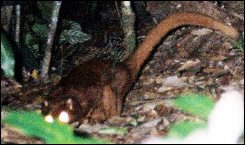
GENEVA (Reuters) - Environmental researchers are preparing to capture what they call a new, mysterious species of carnivore on Borneo, the first such discovery on the wildlife-rich Indonesian island in over a century.
Sunday, December 04, 2005
Just in time...
I had been wondering what I would get Colonel K for Christmas...now I know:
'God's Gift to the World,' the Teaching and Secrets of Divine Energy Transference Healing Revealed for All to Learn and Use
The divine establishment of the US...
The reformation was preceded by the discovery of America, as if the Almighty graciously meant to open a sanctuary to the persecuted in future years, when home should afford neither friendship nor safety.
Thomas Paine
Friday, December 02, 2005
Heavenly penny wax
I firmly know that I have done no more than light a penny candle of yellow wax. But even this flame, trembling in my unaccustomed hands, has brought forth a myriad of sparkling reflections in the treasure-house of the Holy Church. For many centuries, day after day, the treasure has been deposited here—precious stone by precious stone, gold coin by gold coin. Like fragrant dew on fleece, like heavenly manna, the gracious power of God-illuminated souls has descended here. Like the finest pearls, the tears of pure hearts have been collected here. Here, both heaven and earth have heaped their treasures over many centuries. The most secret yearnings, the most concealed aspirations to God-likening; the azure moments of angelic purity that come after the storm; the joys of communion with God and the holy torments of ardent repentance; the fragrance of prayer and the quiet longing for heaven; eternal seeking and eternal finding; infinitely deep intuitions of eternity and the childlike peace of the soul; awe and love, love without end. …Ages have passed, but all this has abided and grown.
St. Pavel (Florensky)
Thursday, December 01, 2005

Wednesday, November 30, 2005
The third Rome
In the first part of the sixteenth century, an elder of one of the monasteries in Pskov, a monk called Philotheus, formulated this widely held conviction. He wrote to the Moscow Prince: 'The Church of old Rome fell for its heresy; the gates of the second Rome, Constantinople, were hewn down by the axes of the infidel Turks; but the Church of Moscow, the Church of the new Rome, shines brighter than the sun in the whole universe. Know, then, pious Prince, that all the realms which hold fast to the Orthodox Christian faith are now gathered together in thy dominion. Thou art the one universal Sovereign of all Christian folk; thou shouldest hold the reins in awe of God; fear Him who hath committed them to thee. Two Romes are fallen, but the third stands fast; a fourth there cannot be. Thy Christian kingdom shall not be given to another.'
Tuesday, November 29, 2005
Azusa-poloosa
The Azusa Street Centennial gathering – one of the birthplaces of modern Pentecostalism – will attract Pentecostals and charismatic Christians worldwide on Apr. 25-29, 2006 to commemorate the 1906 Azusa Street revival.
I think I'll stick to celebrating The Nativity of Christ which is the birth of Christianity...
I refer you to The Pentecostal Movement - Fr. Seraphim (Rose)
Pouff-bang! Limbo no more!
The Roman Catholic [Frankish] Church is preparing to abolish limbo...Limbo has been part of Catholic [Frankish] teaching since the 13th century...It is concerned that the concept of limbo may not impress potential converts.
The most important concern when presenting doctrine...whether it will appeal to the masses! (Of course, this post is not to say I agree with the doctrine of limbo.)

Monday, November 28, 2005
On Evil
…evil is nothing other than an attraction of the will towards nothing, a negation of being, of creation, and above all of God, a furious hatred of grace against which the rebellious will puts up an implacable resistance.
Vladimir Lossky
Sunday, November 27, 2005
Whole Foods
The whole food of Christian Truth, however, is accessible only to faith; and the chief obstacle to such faith is not logic, as the facile modern view has it, but another and opposed faith. We have seen indeed, that logic cannot deny absolute truth without denying itself…
Fr. Seraphim (Rose)
Thursday, November 24, 2005

Wednesday, November 23, 2005
On so-called gays and the Frankish Priesthood
Gay activists reacted with dismay yesterday to a document, endorsed by the Pope, telling Roman Catholic [sic] seminaries worldwide they had a duty to weed out homosexual candidates for the priesthood.
So after thinking about Ted Bundy the last few days I read this story and thought, "hmmm, this whole debate over sodomite priests and those who would have them are like starting a crusade (!) to allow murderers (unrepentant of course) to be priests..."
SCOBA: First Movement
It is the acceptance of God's revelation as found and lived in the reality of the one historical and visible Church of Christ that delimits the beginning and the end of the ecumenical movement for us.
SCOBA guide for ecumenical dialogue
Tuesday, November 22, 2005
Update: Celebrities Unite!
Find a cure so we can get back to our sodomy!
Thanks to Gabe I found an apropos quote to accompany this story. (This accompaniment is not confectionary, however).
Celebrities, who often are "fickle" in backing charities, for more than two decades have supported AIDS causes, citing the disease's toll on art and fashion as well as its effect on their fans, the New York Times reports.
Thanks to Gabe I found an apropos quote to accompany this story. (This accompaniment is not confectionary, however).
There was a time in the 1960s when antibiotics appeared to have conquered syphilis. Together with the birth control pill, this seems to have promoted an increase in heterosexual promiscuity. It was only a short time, however, before a new venereal disease, herpes, made its appearance, a virus immune to antibiotics. It would certainly seem that nature has an interest in the morality that is conducive to the family, and punishes behavior inimical to it. I would suggest therefore that the quest for a cure for AIDS, unaccompanied by any attempt to modify the behavior out of which AIDS was generated, is ultimately futile.
It is my impression, observing the propaganda of the homosexuals—and their gullible coadjutors—that their main reason for wanting a cure for AIDS, is to emancipate them for the unrestrained pursuit of sodomy and for the undiminished pleasures of what would now be called “unsafe sex.” I would venture to suggest, however, that if a cure for AIDS was discovered tomorrow, it would not be very long before a new venereal disease would make its appearance, just as herpes did in the ‘60s and AIDS in the ‘80s. What is needed above all is not a medical miracle cure but a moral and behavioral change.
Harry Jaffa
On Ecclesiality
Where there is no spiritual life, something external must exist as an assurance of ecclesiality. A specific function, the pope, or a system of functions, a hierarchy-that is the criterion of ecclesiality for Roman Catholics. On the other hand, a specific confessional formula, the creed, or a system of formulas, the text of the Scripture, is the criterion of ecclesiality for Protestants. In the final analysis, in both cases what is decisive is a concept, an ecclesiastical-juridical concept for Catholics and an ecclesiastical-scientific concept for Protestants.
St. Paul (Florensky)
St. Basil refutes the "Enlightenment" 1300 years before it commenced
…the corrupters of the truth, who, incapable of submitting their reason to Holy Scripture, distort at will the meaning of the Holy Scriptures…
St. Basil the Great
Monday, November 21, 2005
What is this great abortion debate?
As a longtime pro-lifer, I think anti-abortion groups had solid grounds to oppose the morning-after pill when its function was unclear – as I did. But given what we now know, it's a mistake to keep opposing it. In fact, there are grounds for celebration: A drug once believed to produce abortion is found to prevent it. ... The data compiled on the morning-after pill in recent years make a convincing case that if you oppose abortion, you have no quarrel with Plan B.
Now that science has enlightened us we can separate sex from procreation and take responsibility away from sex, after all, I was "convinced" and all the signs pointed to the fact that sex is just for fun...
Subscribe to:
Posts (Atom)


