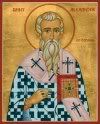
Lord, You have consecrated and given us this light-giving season of abstinence, enable us all to pass through it in compunction and sincerity, living in peace by the power of the Cross, only Lover of mankind!
Hymn of Matins, Wednesday, First week of Lent
Wednesday, February 21, 2007
The light-giving season


Tuesday, February 20, 2007
Spiritual meat
The season of repentance is at hand: show the fruits of abstinence, O my soul! Consider those who repented in the past and cry aloud to Christ: I have sinned, O Loving Master; save me, as You saved the Publican who sighed with sorrow from his heart, for You alone are rich in Mercy!
Hymn of Matins, Tuesday, first week of Lent
Restrain yourself, soul, from harmful passions, from hate and envy and from every evil. Be nourished in the fast with the spiritual meat from Heaven, which is the Word of God.
Irmos of Matins, Tuesday, first week of Lent
As the Lord killed the enemy by fasting, so let us also come to destroy his arrows and spears, saying: get behind me Satan! When he comes to tempt us.
Irmos of Matins, Tuesday, first week of Lent
Monday, February 19, 2007
Apropos to the first day of the Great Fast
For eating is also a matter of habit.
Abba Dorotheos
This is the time of repentance. This is the day of salvation. This is the beginning of the fast. Be vigilant, my soul! Close the door of your passions and seek the Lord.
Let us present a good fast, well-pleasing to the Lord! A true fast is alienation from the evil one; the holding of one's tongue, the laying aside of all anger, the removal of all sensuality, of accusation, falsehood and sins of swearing. The weakening of these will make the fast true and well-pleasing.
The principle of Christianity
People who deny the Church constantly speak about 'evangelical principles,' about evangelical teaching; but Christianity as life is completely alien to them . . .
St. Hilarion (Troitsky)
Saturday, February 17, 2007
Five year plan x2
I know you've all been eagerly awaiting an update on the actions of famed new ecumenical group CCT so I will not disappoint... Having just concluded their "celebration" of formation last week they could not fail to release some "objectives" towards which all "Christians and all people" need to strive.
Being not quite as ambitious as Stalin they will expand their plan from 5 years to 10, but no bother. Before laying out these objectives we must first get you in the "spirit" and remind you that "The Gospel and our ethical principles place our service of the poor and vulnerable and our work for justice at the center of Christian life and witness." (As if stating that "justice's" foundation is in the Gospel isn't enough they have to invoke those ambiguous "ethical principles".) Let's see what St. Isaac the Syrian says about this so-called "justice" talked of in the Gospels, "how can you call God just when you come to the passage about the laborers' wages [Matt. 20:1-16] Where is God's justice? ...Do not call God just, for His justice is not made known in your affairs ...He is good, as He says, to the evil and the ungodly."
Laying aside the fact that the center of the Christian life is actually the Eucharist we'll proceed. Next, to inspire your sense of "justice" some cheerleader phrases and lofty goals would be good, "...we can, we must, do more. Our goal must be the elimination of poverty in this land." I can almost hear Stalin's 1925 era voice through the crackly speaker perched high above red square...
Lest you forget who is calling you to action I will remind you that they are "representatives of almost all the families in Christianity in the United States: Evangelicals/Pentecostals, Catholics, Racial/Ethnic, Orthodox and Historic Protestants." (Grammatical correctness aside, if I had a bad dream and were the "ecumenical officer" from the Orthodox Church present when this was written I think I would have objected to being called an Orthodox Protestant.)
And don't forget kids, in 10 short years you'll be poverty free!
[Edit: See superb article here.]
Being not quite as ambitious as Stalin they will expand their plan from 5 years to 10, but no bother. Before laying out these objectives we must first get you in the "spirit" and remind you that "The Gospel and our ethical principles place our service of the poor and vulnerable and our work for justice at the center of Christian life and witness." (As if stating that "justice's" foundation is in the Gospel isn't enough they have to invoke those ambiguous "ethical principles".) Let's see what St. Isaac the Syrian says about this so-called "justice" talked of in the Gospels, "how can you call God just when you come to the passage about the laborers' wages [Matt. 20:1-16] Where is God's justice? ...Do not call God just, for His justice is not made known in your affairs ...He is good, as He says, to the evil and the ungodly."
Laying aside the fact that the center of the Christian life is actually the Eucharist we'll proceed. Next, to inspire your sense of "justice" some cheerleader phrases and lofty goals would be good, "...we can, we must, do more. Our goal must be the elimination of poverty in this land." I can almost hear Stalin's 1925 era voice through the crackly speaker perched high above red square...
Lest you forget who is calling you to action I will remind you that they are "representatives of almost all the families in Christianity in the United States: Evangelicals/Pentecostals, Catholics, Racial/Ethnic, Orthodox and Historic Protestants." (Grammatical correctness aside, if I had a bad dream and were the "ecumenical officer" from the Orthodox Church present when this was written I think I would have objected to being called an Orthodox Protestant.)
And don't forget kids, in 10 short years you'll be poverty free!
[Edit: See superb article here.]
The Artisan
But what kind of artist on earth can be compared to Christ the Artist, who from illiterate men creates wise men, who from fishermen creates apostles, who from cowards creates heroes, who from the immoral creates saints?
St. Nikolaj (Velimirovic)
Friday, February 16, 2007
The virtue of gluttony
Christianity is food and drink. And the more one eats of it, the more the mind is stimulated by the sweetness; it is uncontrollable and insatiate, insatiably asking for more eating
St. Macarius the Great
Thursday, February 15, 2007
The word of Christ
...what does it mean, brethren, to keep the word of Christ within ourselves? That means; First: to keep the word of Christ in our mind, thinking about it; Second: to keep the word of Christ in our heart, loving it; Third: to keep the word of Christ in our will, fulfilling it in deeds; Fourth: to keep the word of Christ on our tongue, openly confessing it when it is necessary to do so. Thus, to keep the word of Christ means to fill ourselves with it and to fulfill it. Whoever would keep the word of Christ in this manner, truly, he will never taste of death.
St. Nikolaj (Velimirivic)
Tuesday, February 13, 2007
Outward resemblances
All that can be said in regard to the platonism of the Fathers, and especially in regard to the dependence of the author of the Areopagitica on the neo-platonist philosophers, is limited to outward resemblances which do not go to the root of their teaching, and relate only to a vocabulary which was common to the age.May we in like manner speak of the "Western captivity" of Orthodoxy? I think so.
Vladimir Lossky
Sunday, February 11, 2007
In preparation for Great Lent
Today is celebrated the memory of St. Theodora who after the death of her iconoclast husband restored the veneration of icons in 842. Of course this is where the feast we celebrate in two weeks, the Sunday of Orthodoxy, originates. Today's commemorations also "happen" to coincide with the Sunday of the last judgment reminding us that those who do not recognize Christ in "the least of these" will be sent into "the everlasting fire prepared for the devil and his angels". It seems to me reasonable to recognize that seeing Christ in "the least of these" includes many of the saints we venerate on icons. Having recently read the life of St. Symeon of Emesa, fool for Christ, I could not help but see in his life such an example as fools for Christ take on a much more humble position than your run of the mill monk. Recently I posted a great explanation of the fool for Christ phenomenon which well sums up this thought.
And don't forget that today is also the commemoration of St. Blaise of Sebaste the patron of my bosom buddy Bleys, otherwise known as Colonel K.
And don't forget that today is also the commemoration of St. Blaise of Sebaste the patron of my bosom buddy Bleys, otherwise known as Colonel K.
Friday, February 09, 2007
The ludicrous ways of saints
...the all-wise Symeon's whole goal was this: first, to save souls, whether through afflictions which he sent them in ludicrous or methodical ways, or through miracles which he performed while seeming not to understand, or through maxims which he said to them while playing the fool; and second, that his virtue not be known, and he receive neither approval nor honor from men.
Leontius of Neapolis
Thursday, February 08, 2007
D.I.Y.
A brother said to Antony, 'Pray for me,' He answered, 'Neither I nor God will have mercy on you unless you do something about it yourself and ask God's help.'
Sayings of the Desert Fathers
Wednesday, February 07, 2007
Tuesday, February 06, 2007
The speech of faith
Separate aspects of faith disintegrate only for scholastic theology, but, in living life, these aspects, each retaining its independence, become so closely interwoven that one idea imperceptibly evokes another. For a scholastic theologian, it is easy to say that the concepts Church, Holy Spirit, and Son of God are different: easy, because in his consciousness they are only concepts. But for a believer for whom all of these are realities that cannot be experienced independently of one another, realities that are interpenetrating and interconnected; for a believer who perceives them in their living givenness; for whom the Church is tangibly the body of Christ, the fullness of the Spirit sent by Christ; for such a believer, it is painful to make sharp divisions and separations, for they cut through living flesh. The speech of faith is in no wise like the speech of theology, and faith clothes its knowledge of dogmatic truth in a symbolic garment, in figurative language, which covers the higher truth and depth of contemplation in consistent contradictions.
St. Pavel (Florensky)
Monday, February 05, 2007
Don’t fret “Byzantium” was egalitarian
Byzantine architecture, with its interpretation of the Church as the Trinitarian mode of existence, marks out a space which is concrete and yet without bounds, a space continually divided up which yet has its center everywhere. The eucharist is accomplished everywhere, in the place where each Christian is present, bearing in himself Christ and the Spirit.
Christos Yannaras
Friday, February 02, 2007
Have it their way
Walking across campus today I could not help but notice a large RV parked along a campus street. You may ask me what (insert latest pop star here) was doing at my school? I would reply that this was no pop star but the RV of repentance - the tanker of truth - the source of "salvation". What is the best way to spread salvation? To give out Bibles, of course. What if in my reading of the Bible I don't find salvation? Well now, you must read our version as we are "Spreading the interpreted Word of God one Bible at a time." Italics, of course, mine...
It depends on us
Since therefore I am unable to present instruction and the image and model of virtuous deeds from my own life, carrying with myself everywhere the mark of sin, come, and from the work of others and their sweaty toils, I shall today unveil for you a nourishment which does not perish but which leads our souls to life everlasting [cf. Jn 6:27]. For as bread strengthens the body, the word of God often awakens the soul to virtue in earnest, and especially the souls of those most slothful in the work of divine commandments and disposed to carelessness. For the zealous, those whose intention is directed toward God, it is sufficient for their conscience to set them in the presence of instruction, recommending all good things and dissuading them from evil. Those more humble than these need to have the commandment of the written law set before them. But if someone escapes both from the first and from the second type of path which leads to virtue, it is necessary that from the zeal and concern of others, which he sees before his eyes, through his hearing, aroused in him to shake his soul from its sleep, that he may travel through the straight and narrow path and begin eternal life now. For it depends on us and lies within our power either to despise the desire for things which come in the present because they pass away, or, in the desire and longing for present things, to lose the unceasing good.
Leontius of Neapolis
Thursday, February 01, 2007
What might happen?
Advertisements have penetrated American life to such an extent that, if upon waking some amazing morning Americans were to find all advertisements gone, the majority of them would be in the most desperate of plights. ...without advertisements, the devil alone knows what might happen!It goes without saying that this is now true for most of the modern world. This comment was made early in the previous century before advertising had spread in talons over the world outside America.
Life would become incredibly complex. One would have to think for himself at every step.
No, it is much easier with advertisements. Americans don't have to think about anything. The large business houses do the thinking for them.
Ilya Ilf and Eugene Petrov
Wednesday, January 31, 2007
The pre-existence of souls?
We already existed before this world, because our creation was decided by God long before our actual creation. Before our creation we therefore existed in the thought of God, we who later turned out to be intelligent creatures of the Divine Word. Thanks to Him, we are very ancient in our origin, because 'in the beginning was the Word.'
St. Clement of Alexandria
...the World-generating Reason also considered, in His mind's great representations, the images of the world formed by Him, this world which was generated later, but, which, for God was present even then. Everything is before God's eyes: what will be, what was, and what is now. For me such a division is set by time: that one thing is ahead, another thing behind. But for God all merges into one, and all is held in the arms of the Great Deity.
St. Gregory of Nazianzus
So I almost fooled you didn't I (or rather St. Clement did)? Upon the first few words you were thinking, "What's going on here?" But then you realized this is a much more lofty idea than some measly pre-existence of souls.
Tuesday, January 30, 2007
The fools for Christ
...seem to reject the Apostle Paul's admonition to accept any personal deprivation and sacrifice in order to avoid scandalizing the faithful (1 Cor. 8:13). But what kind of scandal is St. Paul talking about? It is something that causes confusion in the realm of truth, and may thus deprive others of the possibility of participating in truth--the possibility of salvation. If by eating food offered to idols you give your brother's 'weak conscience' grounds for supposing that there is some connection between idol worship and the truth and life of the Church, then the responsibility for the confusion you cause is great indeed.
The challenge of the fools, however, does not create confusion in people's faith, nor does it obscure the Church. It simply surprises those who have identified faith and truth with the secularized concept of moral uprightness and conventional decorum. Fools for Christ have the gift, and the audacity, to manifest openly the human fall and sin which is common to us all: this is the reality of our nature, and it is not cancelled out by individual cases of 'improvement,' nor by concealment behind social externals.
In this sense, every monk in the Orthodox East is a kind of 'fool for Christ.' He wears a garment of mourning, openly declaring that he accepts our common fall and sin; and he withdraws into the ascetic life, waging war on this fall and this sin on behalf of us all. This same acceptance is the calling of every member of the Church. If we persist in ignoring the Gospel of salvation and continue to identify the regeneration of man with the social recognition of individual virtues, with worldly success in gaining individual moral respectability, then the fault is ours alone--and it is an error which bars us from truth and life.
The prototype to which the Church has always looked is not individual moral self-sufficiency, but the monks' lament of repentance. This lament is ultimately joyful--a 'joyful sorrow'--and turns sin into a measure of the acceptance of Christ's love. Man is able to mourn and lament only when he knows exactly what he has lost, and experiences this loss as a personal deprivation, a personal thirst. This is why repentance, the personal sense of the loss of God, is also a first revelation, our first acquaintance with His person, our first discovery of the extent of His love.
In the case of the fools for Christ, certainly their shocking freedom from every law, rule, restriction or code of obligations is not simply didactic in its purpose, reminding us of the danger of identifying virtue and holiness with conventional social decorum and egocentric moral rectitude. No one can ever really teach simply by calling into question mistaken concepts and ways of life: one has to make the fulness of the saving truth incarnate in oneself. The shocking freedom of the fools is first and foremost a total death, a complete mortification of every individual element in their lives. This death is the freedom which can break and destroy every conventional form; it is resurrection into a life of personal distinctiveness, the life of love which knows neither bounds nor barriers.
The example of the 'fools for Christ,' then, is neither extreme nor inexplicable, as it may perhaps seem to many people. It is the incarnation of the Gospel's fundamental message: that it is possible for someone to keep the whole of the Law without managing to free himself from his biological and psychological ego, from corruption and death. And that on the other hand, it is enough is someone humbly accepts his own sin and his fall, without differentiating it from the sin and fall of the rest of mankind, trusting in the love of Christ which transfigures this acceptance into personal nearness and communion, into a life of incorruption and immortality.
Christos Yannaras
Subscribe to:
Posts (Atom)